Date: 2026-01-06 16:42:59 | Story: Tiffany Adams | Photography: Rett Peek | Styling: Stephanie Maxwell Newton |
Roy Dudley, the don of Arkansas estate sales, invites us on a tour of the collections and curiosities inside his Little Rock abode
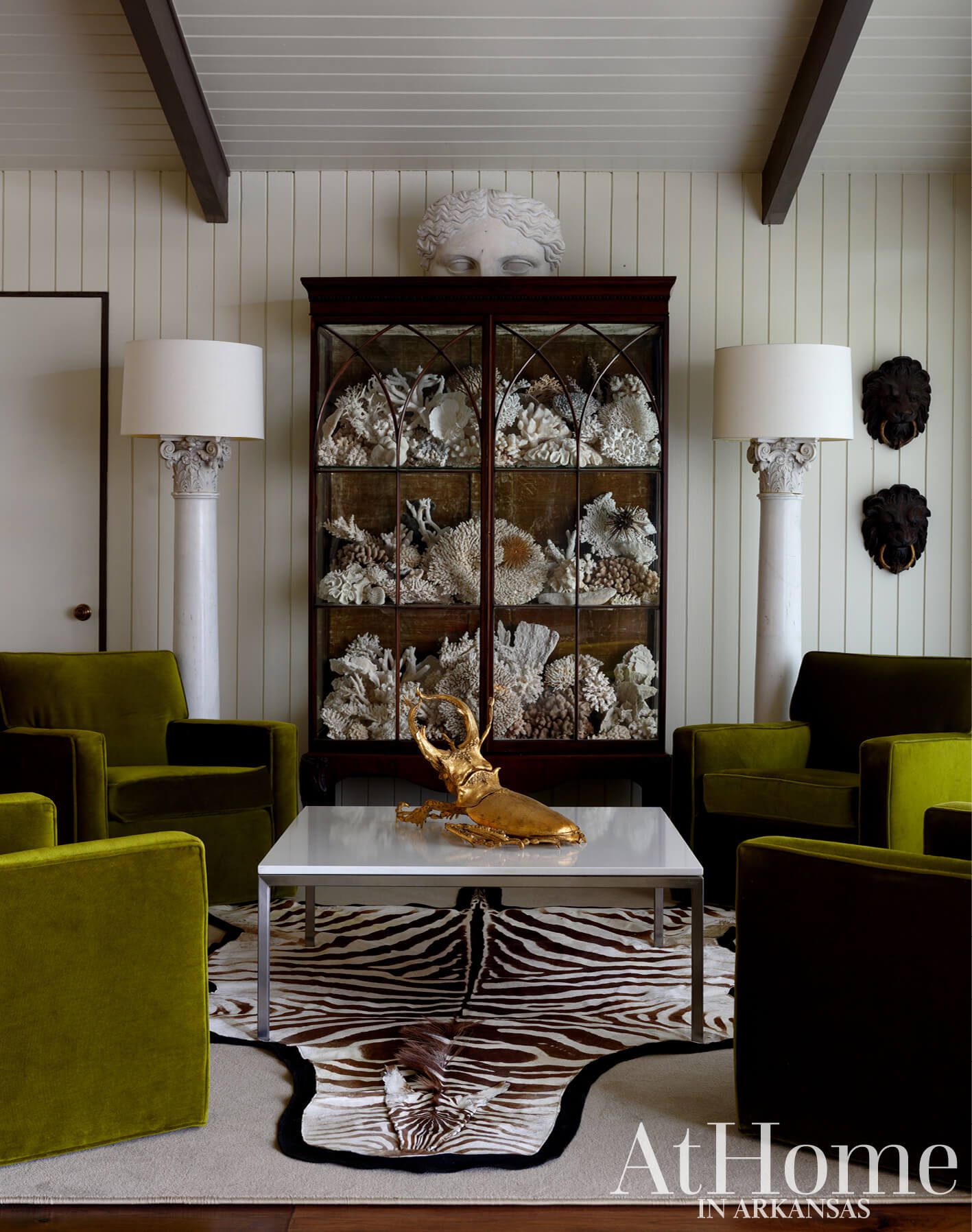 This is my baby,” Roy says of a Georgian cabinet that holds his beloved collection of coral. Accumulated over five years, with many pieces coming from friends and clients, the grouping has become a favorite of his. “I thought if I do china in that cabinet it’s going to look mamaw, but the coral looks like a scientific display,” he says.
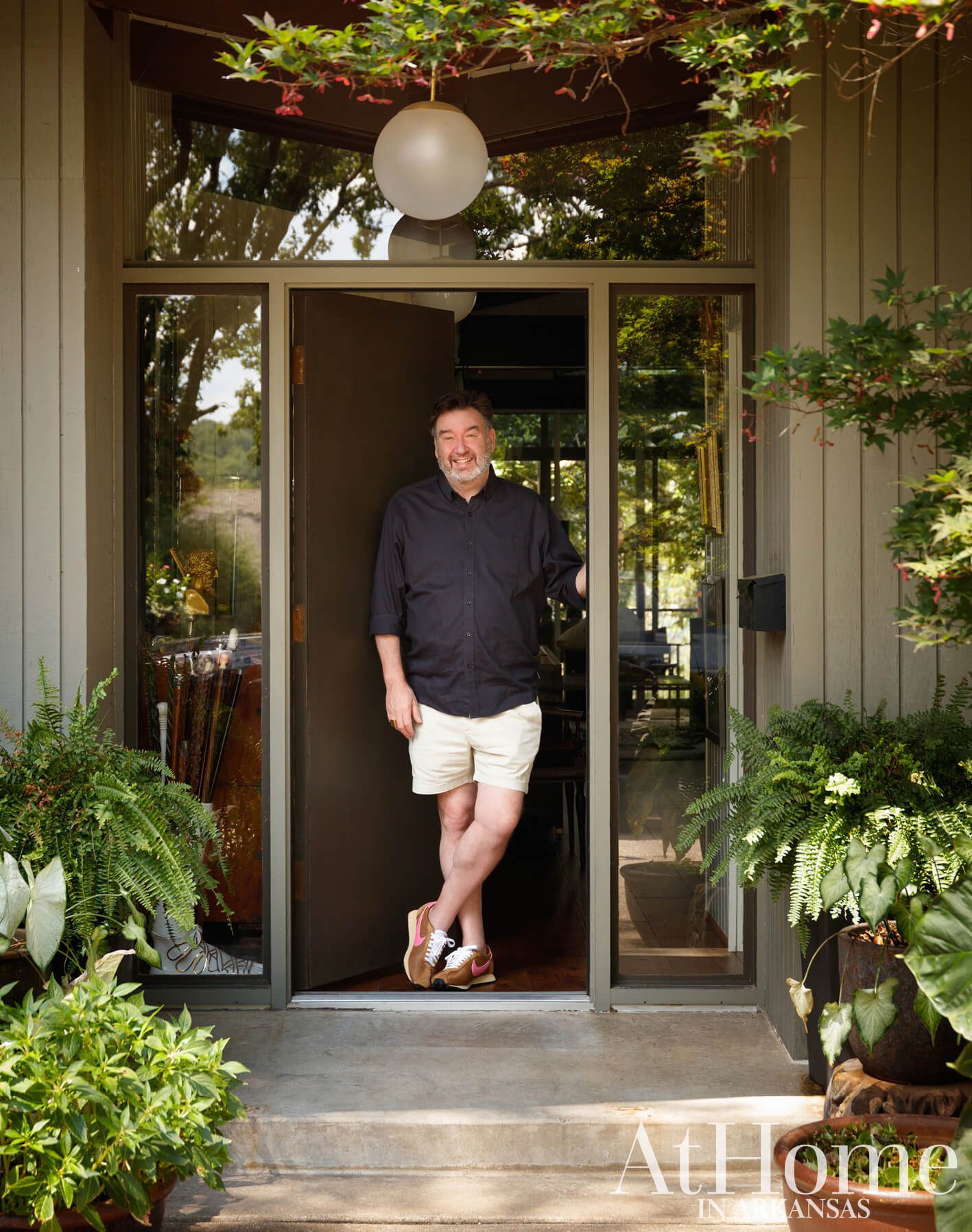
As the owner of Roy Dudley Estate Sales, Roy Dudley is lauded for his ability to find a diamond in the rough again and again. It’s a knack that seems to come naturally as does his knowledge and willingness to educate others. Whether it’s informing a customer about the differences between a $400 tea caddy and a $40 one or offering appraisals on “Arkansas Treasures,” an Emmy Award-winning PBS series where he evaluates collectibles and heirlooms, his interest is apparent and openly shared. We sat down with him to find out how he got his start, what he hopes customers gain from him, and what he can’t live without in his own personal collections.
At Home in Arkansas: How did you fall in love with antiques and vintage pieces?
Roy Dudley: I grew up in Northwest Arkansas, outside Fayetteville before any of the boom. My senior class at Elkins had 24 people, so a really rural area. My parents were very proud Arkansans and were very interested in the ways of the past and did a lot to preserve that. They decided to build an 1850s-style cabin on part of our farm. A man came from Oklahoma to hew the logs and make the shingles and build this cabin just like it would have been. They built the cabin and then we had to furnish it. My mother wanted a round oak dining table, a certain kind of kitchen cabinet, and a black stove, and we would go to auctions to find those things. Pretty soon she had everything she needed, and then she started filling barns. I would have a little money and go with her. At the end of the auction, they would sell everything on the end of the porch for $3, so I would pay and load it up in the truck.
“Sometimes the beauty is that it survived, not that it’s perfect.”
—Roy Dudley
AHIA: So, you grew up with this; it’s almost in your blood. How did you figure out you could make a career out of it?
RD: My mom’s sister, my Aunt Hazel, lived in West Fork, and she ran a perpetual yard sale with quilts and things like that. All the game traffic before the bypass would stop there on the way to Fayetteville. I would take my stuff to her and she would ask, What did you pay for all of this? and then we would root around in it and she would say, See this lamp, we’re going to put $3 on it and when it sells your inventory is paid for and the rest is profit. Her rule was I had to be there and I had to help her put the stuff out. At the end of the weekend, she would say, You made $38, so when you deduct your $3 you have $35 profit; and then Hazel, ever the businesswoman, would say, And you owe me 20% for selling your items. Basically that same parallel that I learned at 7 or 8 years old—Aunt Hazel’s model—is my business now.
AHIA: Did you have any other mentors along the way?
RD: I encountered a man named John Banks from Fayetteville. He was probably one of the wisest, savviest, and smartest antiques dealers, and he sort of took me under his wing. John was the type to say, This is an early chair, do you know why it is an early chair? Then he would show me the construction and let the piece tell me. And then, he would say, This looks old but it’s not. Why not? Basically it was an immersive training with someone who was funny and knew what they were doing. My mother and John and I went to auctions, and he was very knowledgeable about Arkansas-made things including furniture, fabrics, and silver. There was a piece of early Arkansas silver at this one auction. It was labeled “tin cup,” but it was a sterling beaker made by an early Arkansan from the 1840s. We’re all excited and waiting for him to get it and trying to keep our cool. He sold it to the Historic Arkansas Museum for $2,500 and gave me the money to start my business.
AHIA: You are surrounded by so many beautiful pieces in your showroom and at sales. How does this carry over into your home?
RD: A lot of people think, Oh you probably just pick all the good things from the sales. That’s not so. Very few sales have this kind of stuff, and the things in my house are pieces I buy from different friends and from auctions, and then here we are with a house full of curiosities—my little cabinet of curiosities is what I call it. It’s just a lifetime of hunting and gathering. The thing I have to think about is refinement. This is the house that I’m going to be in forever, so the rule now is that if something comes in, something must go out.
AHIA: What about the display part of the business? Does it come naturally to you and do you like to style or arrange pieces in your own house?
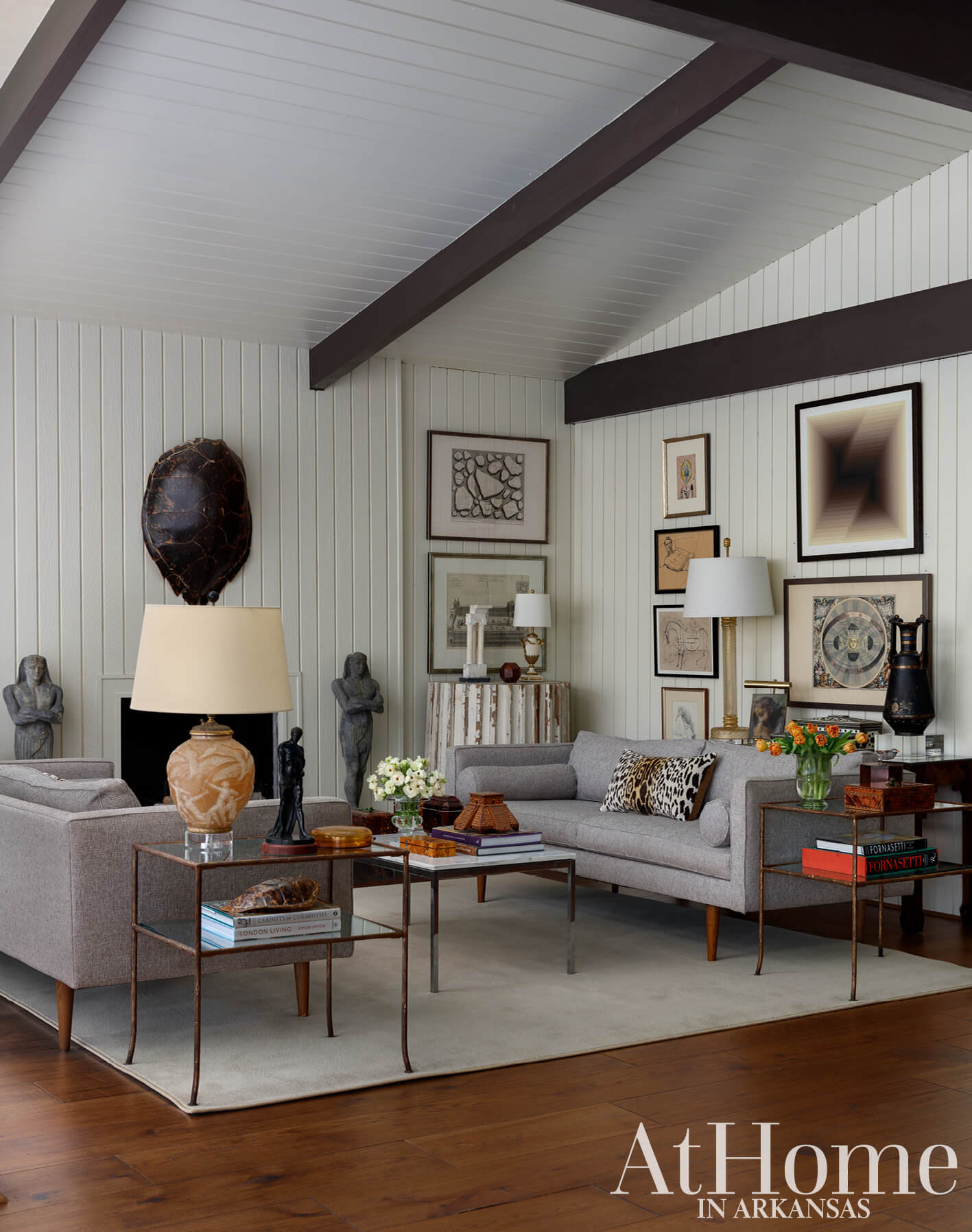
RD: Displays are not my favorite in the store. In my house, I like to do it because I’m a purist; I want to keep everything together. I know my stuff, and I like my stuff, but I couldn’t make it work because I had never lived in a wide-open house. That’s why Patrick Phillips and Glen Johnston were so helpful. I had been following Patrick on Instagram and decided to call him. The things he posted were things I liked—not projects necessarily but things like a book on Bill Blass’s country house. I felt like my house was crowded and empty, if that makes any sense. They came in for two days and rehung art, scooted some of the furniture around, and angled the green chairs. They sort of reconfigured everything. It changed the whole house, and they only sold me two pillows. So it wasn’t like a re-do or we’re going to take over your life, they just came in and worked with what I had. I think they just did an incredible job. My only rule was for them to put what they didn’t like in the basement.
AHIA: What advice do you have for collectors who might be just starting out?
RD: I’ve always heard you should start with a good mirror. A good mirror will set the tone for your whole house. You should buy original art. I did what everyone else does—I bought posters and framed them and thought I was jazzy. But, in every sale I have original art that is cheaper than poster art. Buy stuff that makes your heart happy. Buy what you like, invest in good one-of-a-kind things and that will set your house apart—those things are out there. In a lifetime you can do something, you can assemble a really neat collection, it just can’t be done overnight.
“My mom instilled a love of antiques and buying antiques. My Aunt Hazel instilled a love of selling antiques.”
—Roy Dudley
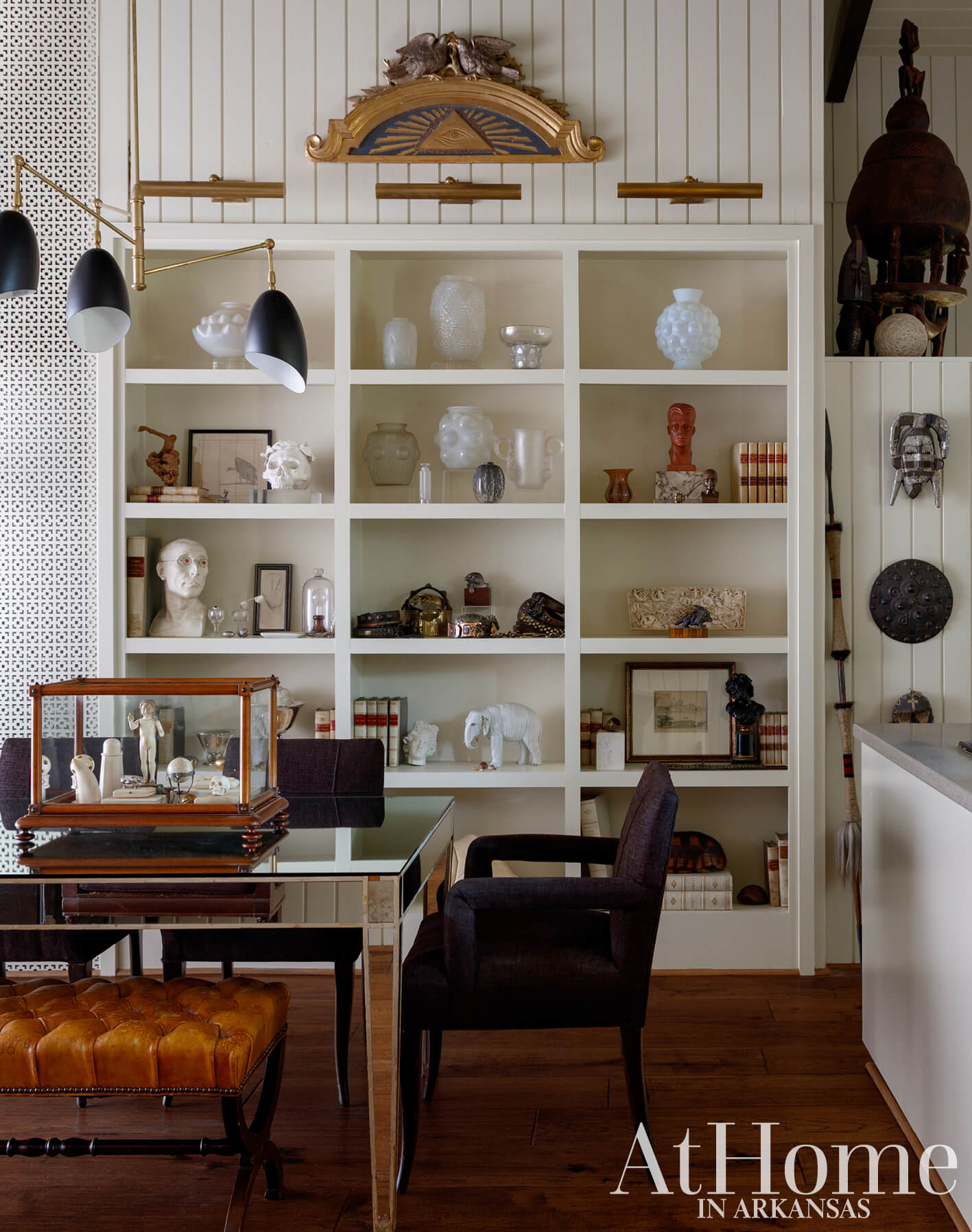
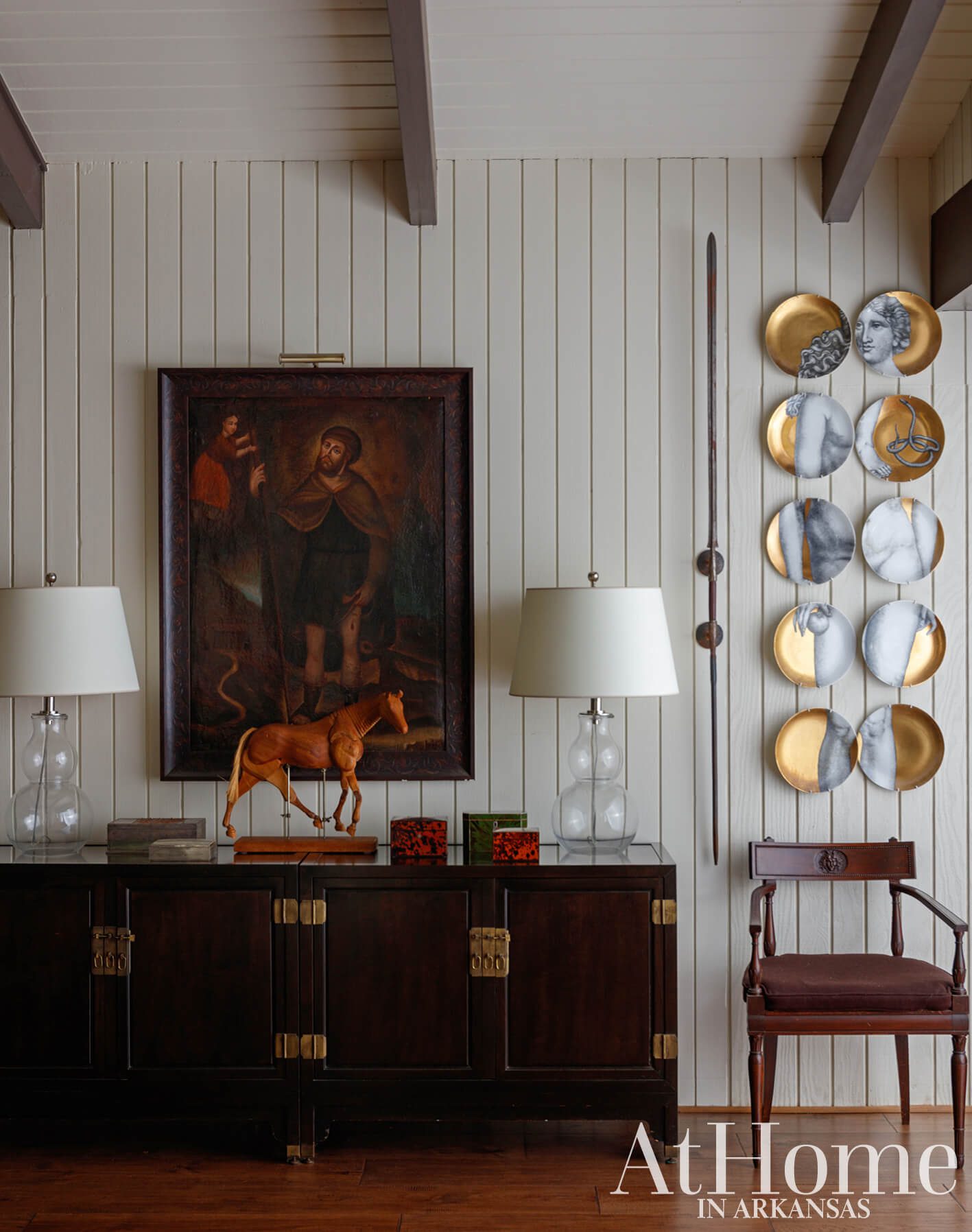
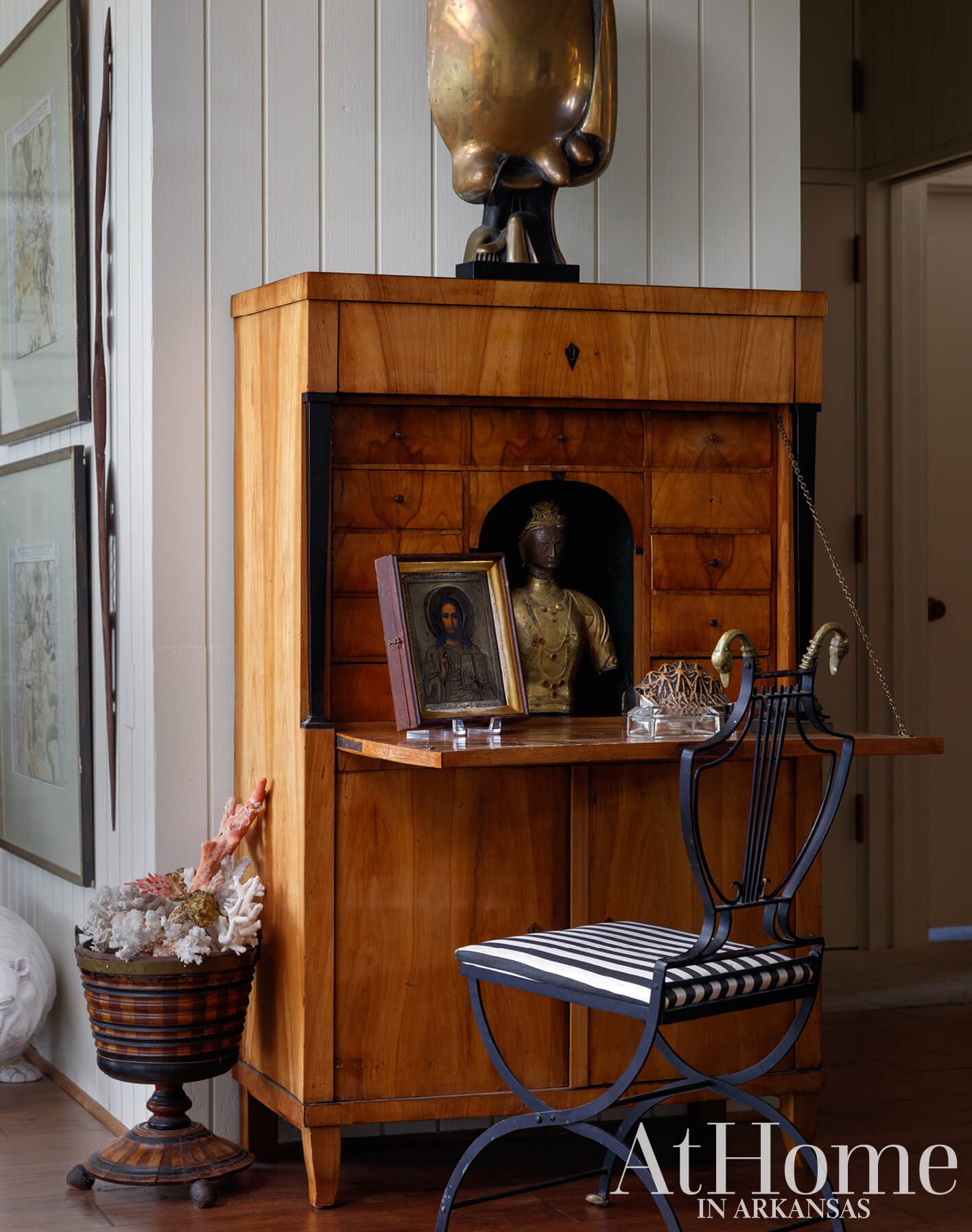
A painting of St. Rocco, the patron saint of epidemics, bachelors, second-hand dealers and dogs, among other things, seemed like a fitting addition to the home. It sits next to an African spear and a collection of gold plates by Fornasetti that depict Eve in the Garden of Eden, which were from a 1950s Bahamian resort.
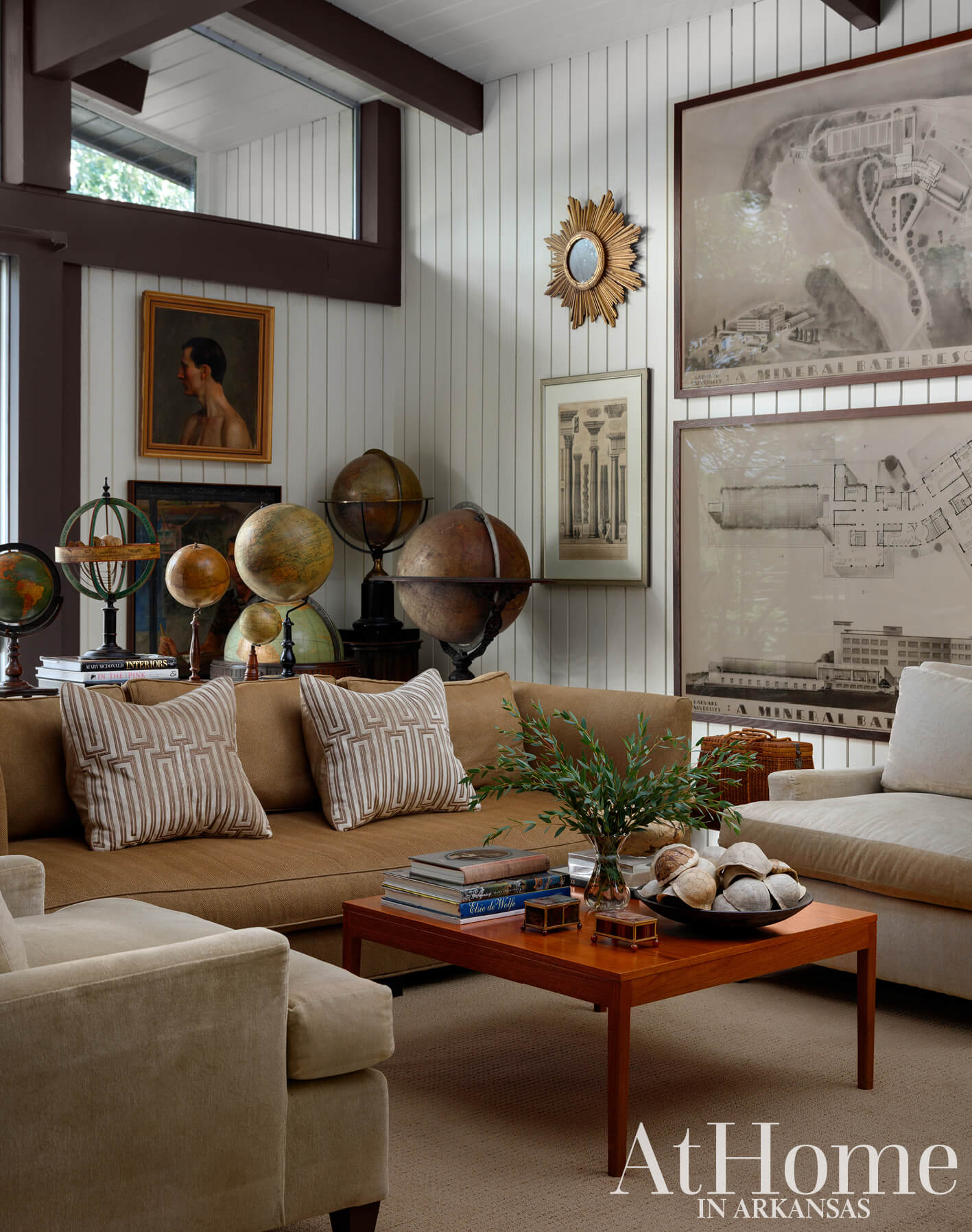
The sitting area of the primary bedroom is home to Roy’s collection of globes along with a pair of architectural drawings Bruce R. Anderson, who designed War Memorial Stadium, produced for his senior project at Harvard University.
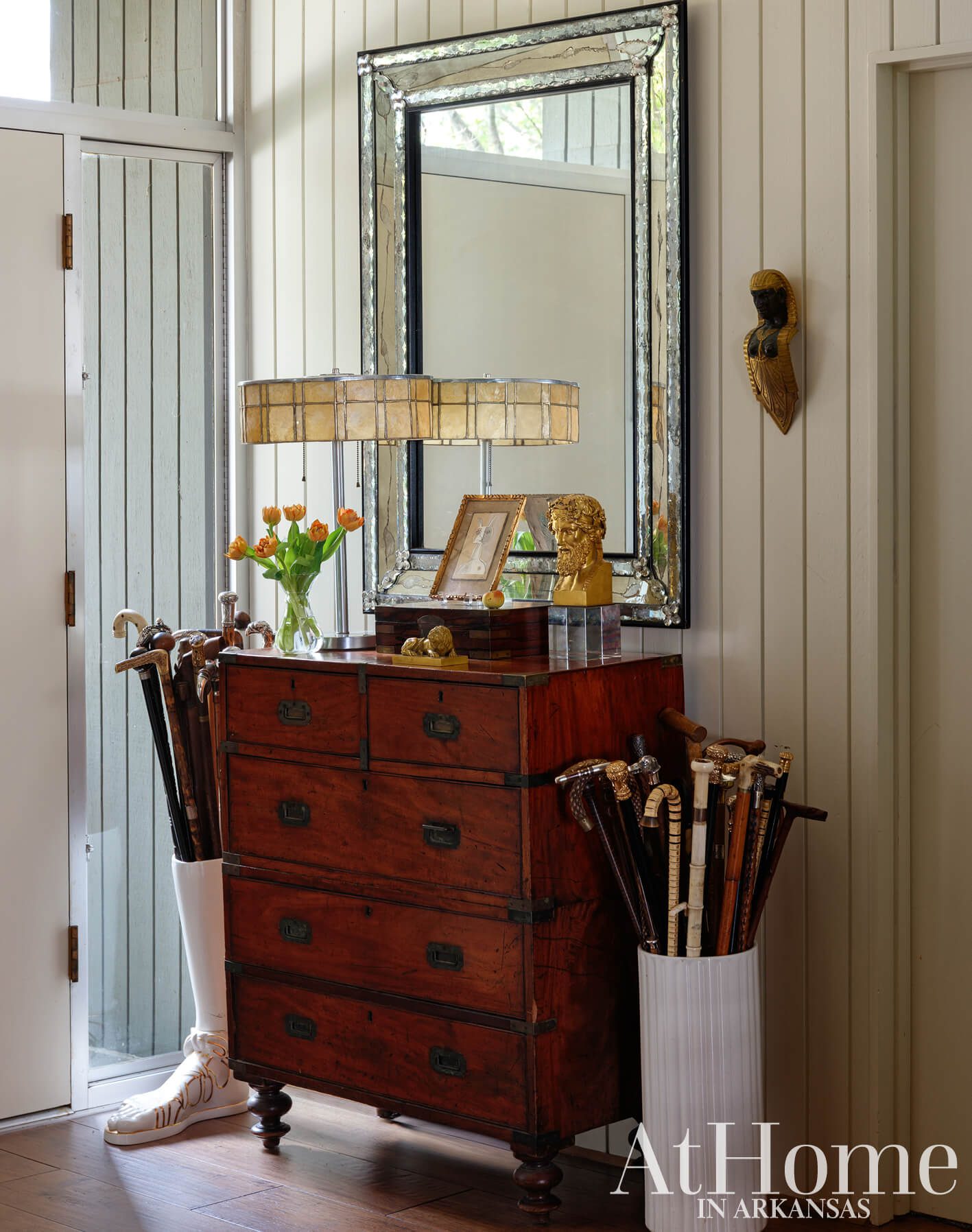
A grouping of walking sticks, one of which is contained in a sculpted Fornasetti container that has the look of a leg, and a campaign chest greet guests at the door.
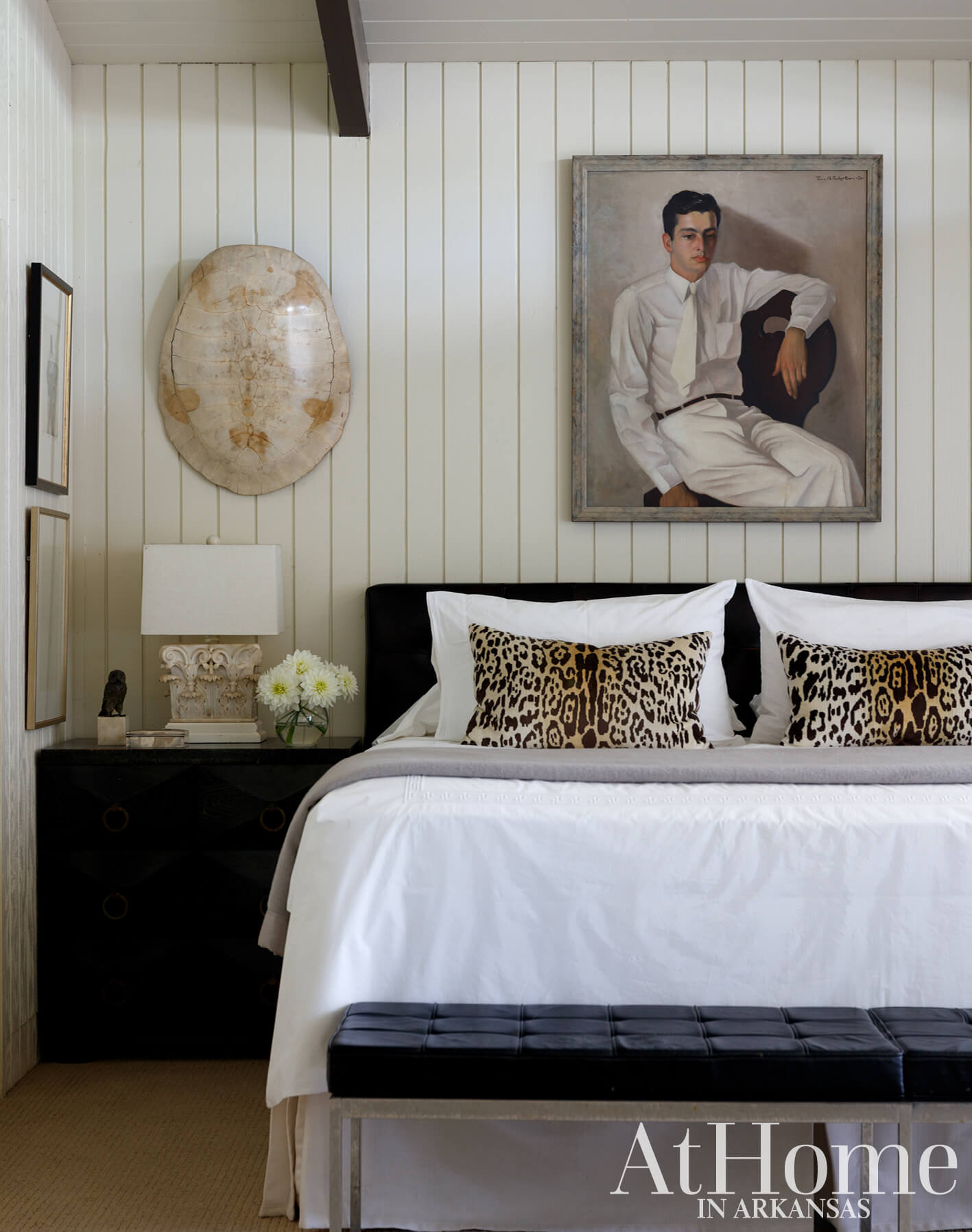
The artwork over the bed is a self portrait of Arkansas artist Tom Roberston from the 1930s.
“I love my tree and the secluded look. The view from the living room is like a treehouse.”
—Roy Dudley
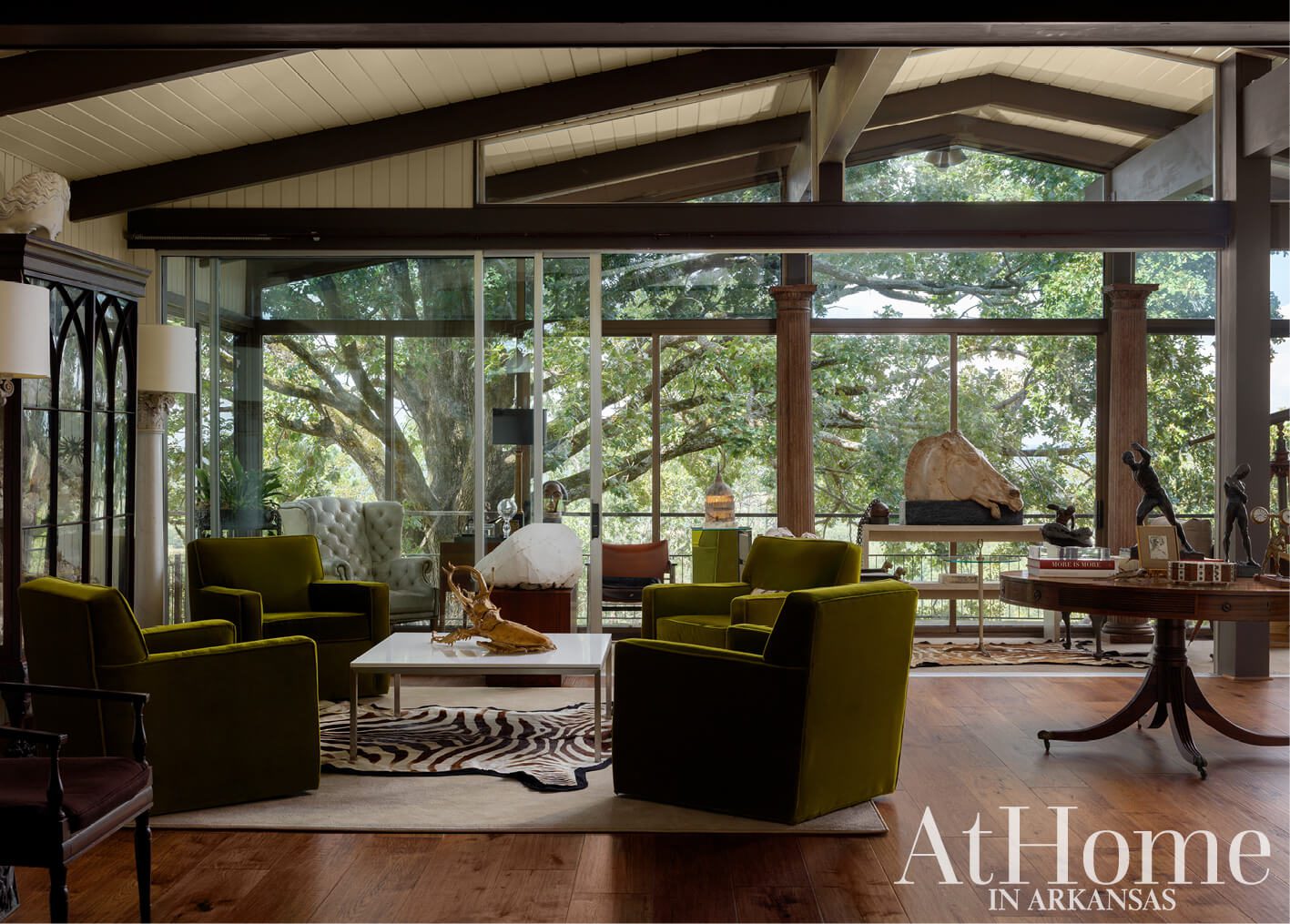 Perhaps unsurprisingly, Roy happened upon what is now his home—a 1970s Hillcrest abode designed by the late local architect Gene Withrow—while meeting with a client to preview an estate.
Design Resources
Interior Design Patrick Phillips and Glen Johnston, Phillips and Johnston Accessories and furniture Roy Dudley Estate Sales Art Gallery 26 Carpet C&F Flooring and Rug Gallery Lamps The Shade Above
