Date: 2014-11-28 20:39:31 | Story: Tiffany Burgess Adams | Styling: Mandy Keener |
A Little Rock collector who is passionate about Christmas items shares the history of the popular American-made Shiny Brite ornaments
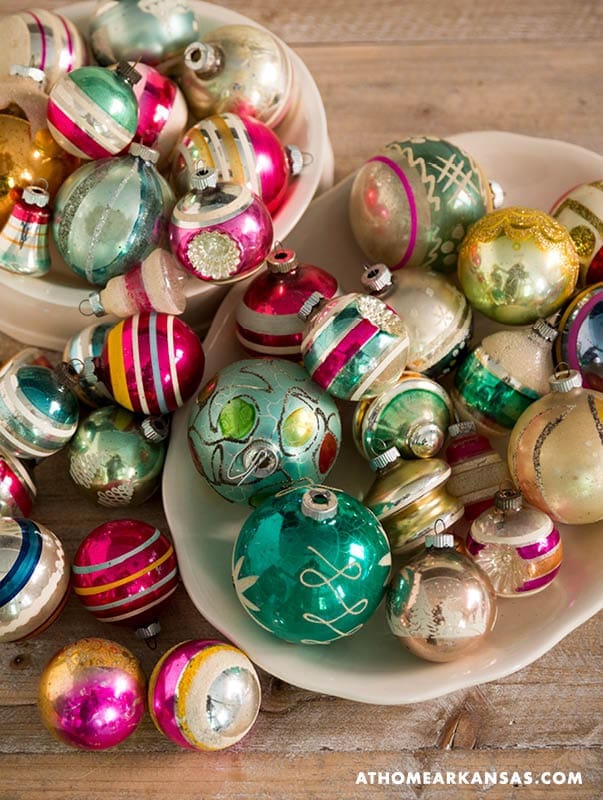
Charles DuVal has had a lifelong fascination with all things Christmas. “When I was a little boy my mother had me decorate our Christmas tree. I was very particular about where each ornament went; the lights had to be just right and the tinsel had to be just right. I was just very interested in Christmas as a child growing up,” he says.
Even into adulthood, DuVal’s passion for Christmas and ornaments did not wane. However, he did not get into collecting until the 1980s while operating a booth in a large flea market. “There was a lady there who only had Christmas in her booth—and specifically only wanted items that were made before 1920. She began to not be able to find these older items, so she gave up her booth. I asked her what she was going to do with her stuff and she said, ‘I threw all the “new” stuff from the 1950s into the dumpster.’ I closed my booth and went straight to the dumpster,” DuVal says with a laugh. Unearthing these items brought back warm memories for him, and he began to seek out Christmas decorations, including the Shiny Brite ornaments featured here, to add to his collection and to sell to others who wanted their own collections.
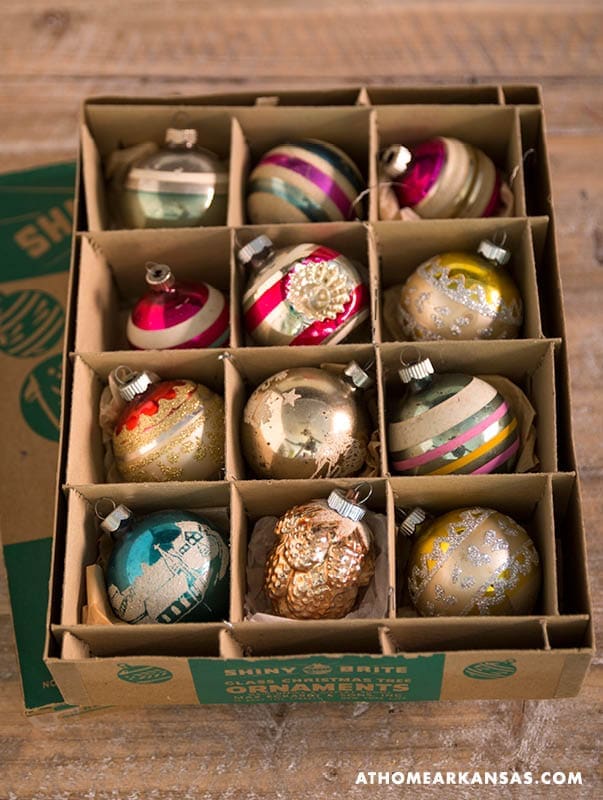
“Shiny Brite was the first company in the United States to produce ornaments, starting in 1937,” DuVal relates. A man by the name of Max Eckardt had seen the rise in popularity of the German cottage-industry-made ornaments and sought to bring ornament production to the U.S. Eckardt made a deal with Corning Glass Company to make these in New Jersey, and in 1940 the company shipped out their first orders. Through the years they came to produce 180 styles and shapes, including balls, pincones, top-shaped pieces, and ornaments with indented designs, according to DuVal. What’s more, they were able to create approximately 400 ornaments per minute, which was much faster than the cottage industry standard.
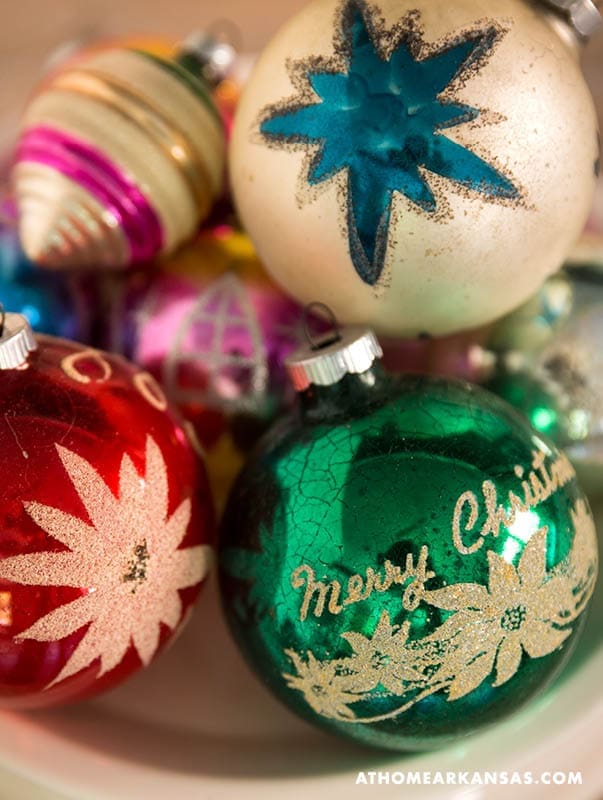
What sets the Shiny Brite ornaments, like the ones shown here, apart from other mass-produced ornaments is their unique base color. DuVal explains that this luminescent look was created by coating the inside of each glass ball with silver nitrate—a highly volatile inorganic compound. However, during WWII both silver nitrate and the metal used for the ornament tops and hooks went to war efforts. Shiny Brite modified their design by creating clear glass ornaments with their signature bright stripes and scenes painted on the outside and by using a piece of cardboard for the topper with a hole for string or yarn to loop, thus creating a way to hang the decoration on your tree. “The fact that they were made in the U.S.A. was a huge selling point during the day,” DuVal notes. Another feature that only Shiny Brite ornaments have is a corrugated aluminum cap. “They are the only ones who did this,” DuVal says, which makes it easy to identify Shiny Brite pieces.
While the production of Eckardt’s original Shiny Brite tree decorations stopped decades ago, the attractive vintage ornaments have experienced a resurgence in popularity. In 2001, well-known ornament designer and manufacturer Christopher Radko got permission to reissue Shiny Brite styles. Today, the reproductions of many of the classic shapes and colors are available through national retailers.
