Date: 2024-10-01 06:31:40 | Story: Rebekah Hall Scott | Art Direction: Bailey Dougan |
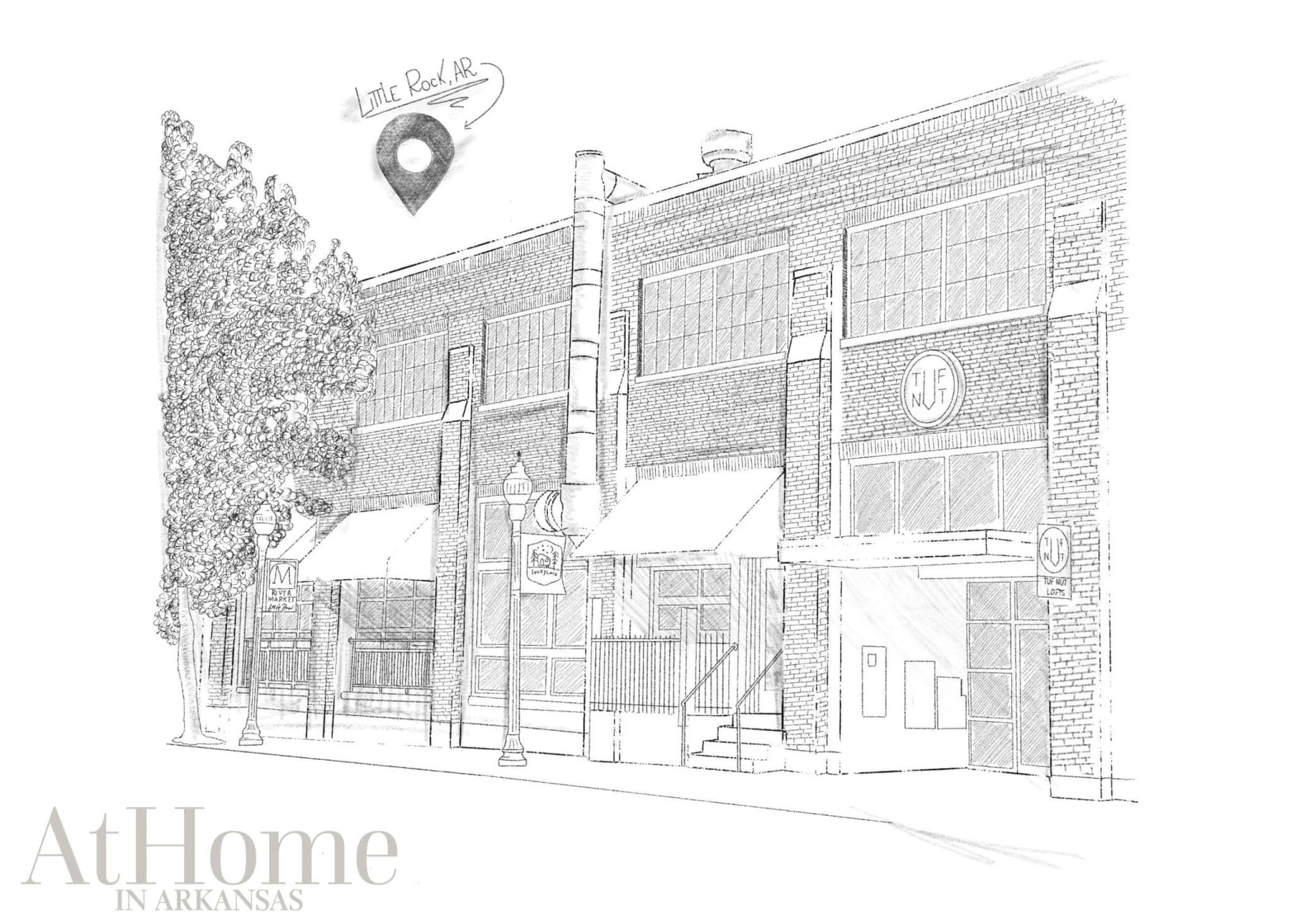
During the 1920s economic boom in downtown Little Rock, many new commercial buildings were constructed to accommodate the rapid growth. Among them is the Little Rock Tent & Awning building at 423 East Third Street, which was constructed in 1927 and is a part of the Tuf Nut Historic District. The dark-red brick structure includes large multiple-pane windows with awnings spanning the elevation, and bands of cast concrete decorating the parapet, or roof line, as well as the window ledges. In 1930, Little Rock Tent & Awning bought the nearby Tuf Nut Garment Manufacturing Company, relocating that business to the East Third Street building and combining their manufacturing production.
The business remained here until the 1970s, when the company closed. The building was next used as a warehouse by a local industrial supply business, then vacated. In 1999, Moses Tucker Partners approached Warren Stephens, who owned the space at the time, with the goal of converting it into residences and commercial spaces.
“We thought that in order for us to have a really vibrant neighborhood in downtown, and for this River Market idea to take shape, we’ve got to have housing,” says Jimmy Moses, principal of Moses Tucker Partners. Stephens agreed to sell the building and also became a partner in the project. Margaret McEntire, founder of Candy Bouquet International, was another significant partner on the renovation. Once completed, she moved her corporate headquarters into the building and operated there for more than 15 years.
Jimmy says he had long admired the building, so it was important to him and his team to maintain its historic character. “The building has wooden timbers for a structural system, and we exposed them,” he says. “All of the walls are brick on the interior, and we left them all brick. Even the concrete floors, from where the sewing equipment was, we left that all in place.”
They constructed 31 apartment units on the second and third floors of the building and reopened in 2000. As part of the Tuf Nut Historic District, it was added to the National Register of Historic Places in 2003. Now, the building features Flora Jean’s, 10 Fitness, Lucky Lou’s, and other commercial spaces. “Saving all of these buildings like Tuf Nut is really important to continue to give Little Rock its own identity, and downtown its uniqueness,” Jimmy says. “My hope is that it will sit there for another 100 years, irrespective of what the uses are.”
Illustration by Bailey Dougan
