Date: 2015-09-24 11:33:45 | Story: Tiffany Adams | Photography: Rett Peek | Styling: Chip Jones |
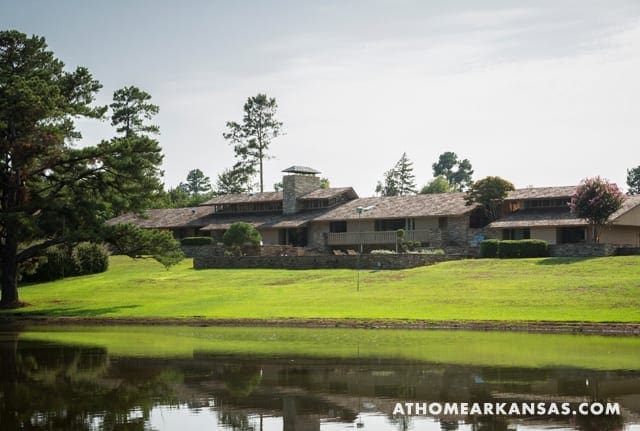
On the outskirts of Magnolia, a home designed by famed Arkansas architect Fay Jones is celebrated for its organic beauty and iconic design

It’s not every day you stumble upon a home designed by an architectural icon, especially when the structure is located in a heavily wooded area on the outskirts of a town with a population of fewer than 12,000 residents. For M. Bruce Woodward, happening upon such a dream home seemed to be in fate’s hand. “My family is from Magnolia, and I had known for years there was a Fay Jones house here but had never seen it,” he says. “A good friend and client of mine who is an attorney was going to do some depositions in Magnolia. She asked if I would go with her. We had some time to kill, so I said there’s a Fay Jones house on the other edge of town—let’s go see if we can find it. I drove up to it and there was this big ‘For Sale’ sign. So it was really kind of weird…I really felt like it was meant to be,” Woodward says of the experience.

Worth the Wait
Though it had seemed too good to be true, what Woodward and his friend saw on their day trip in 2010 proved to be beyond expectation, so he began to dig deeper to learn more about the property. Turns out he wasn’t the only one who waited a substantial amount of time to see the home. The original owners, Janice and James Polk, waited a year from the date of their initial request to be able to talk with Jones—who by this time had been heavily influenced by the work of his friend and mentor Frank Lloyd Wright—about the possibility of building the home. After that, the project took four years to design and construct before its completion in 1970. The Polks were the only owners before Woodward purchased the house and surrounding property, which now serves as a country home for the Little Rock resident.
Blurring the Lines
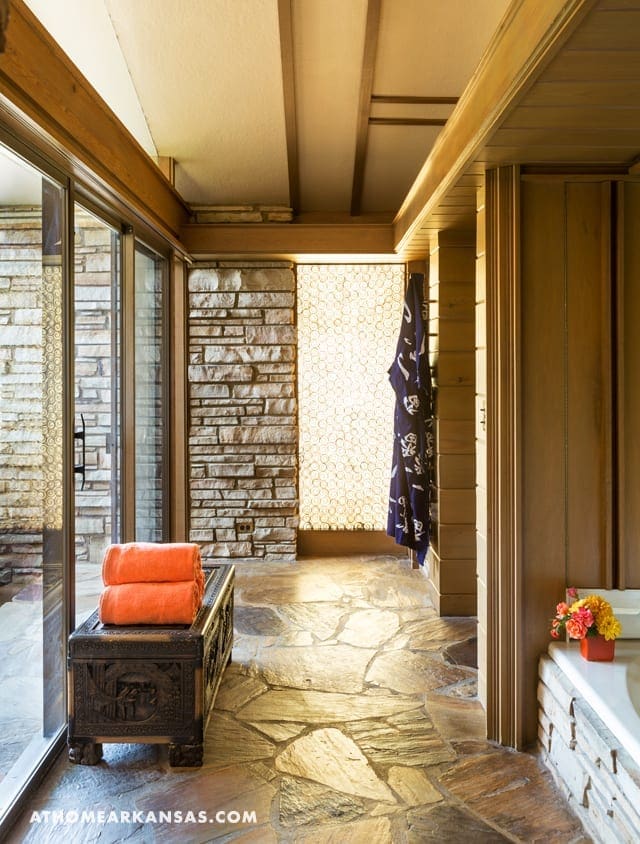
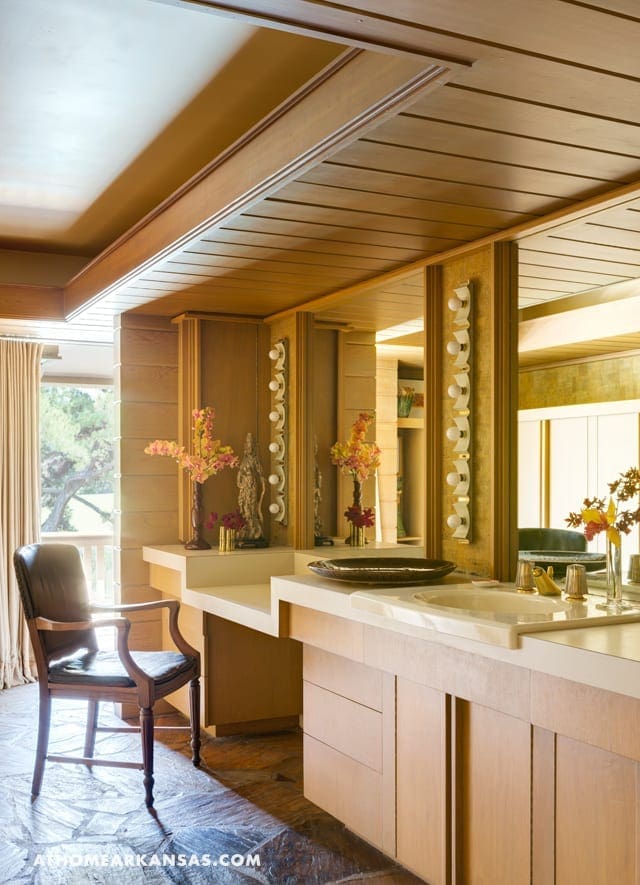
In line with Jones’s style of blending interiors and exteriors by using an uninterrupted flow of materials in the two spaces, Woodward notes that the home has “a sense of continuity throughout the entire structure.” He goes on to say, “[All of Jones’s houses] were designed to go inside and outside, so the lines between the spaces are completely blurred and as much attention is given to the exterior space as the interior. That’s one thing that really makes the houses special to me.” Stone flooring runs from the home’s exterior walkways and pool surround into the home’s interior borders and into the sun trellis that is situated along the façade. “Because the sun trellis continues indoors, this continuation is a trick for the eye,” Woodward adds. A guesthouse, which sits at the south end of the home, has a walkway that leads to the sun trellis, giving guests a way to enter the home without coming through the master bedroom (which is positioned next to the guest house).
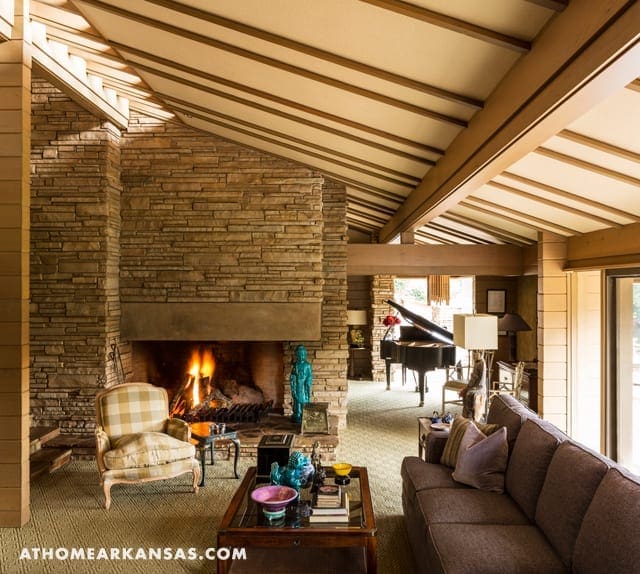
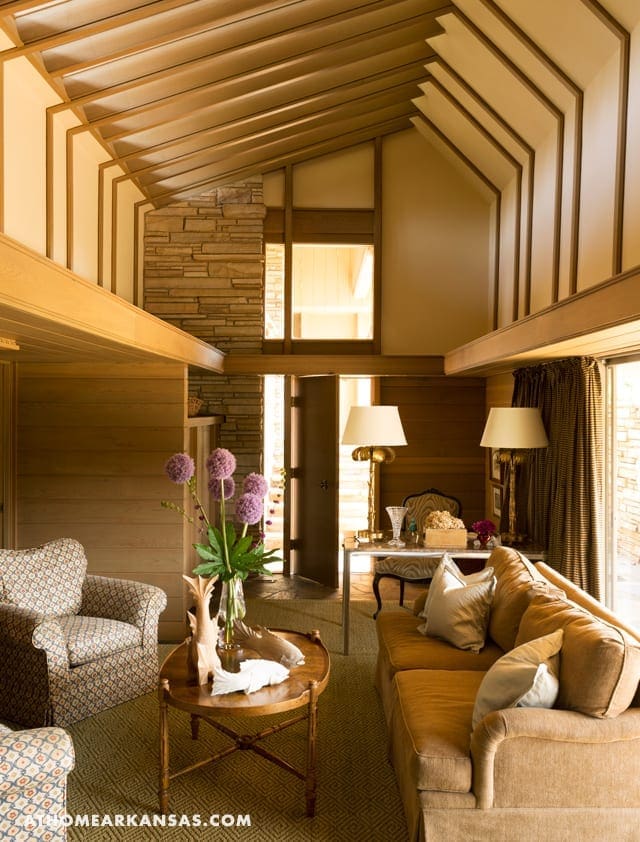
The interesting play of light and shade created by the home’s clerestory—which serves as a natural light source—is most evident in the living room. The feature led Woodward to name the home Stoneshadow. “Some of [Jones’s] houses had names from the get-go and some didn’t. With the stonework and the shadowing in the house, we thought that was fitting, and I think this went with his thinking and philosophy,” Woodward says.
Historical Features and Furnishings
“A big thing for Fay Jones was the fireplace. It’s the center of the space,” Woodward says of the architect’s signature approach. Stoneshadow is no different; a large fireplace is centrally installed in the living room and can be seen from a number of vantage points and nearby rooms.
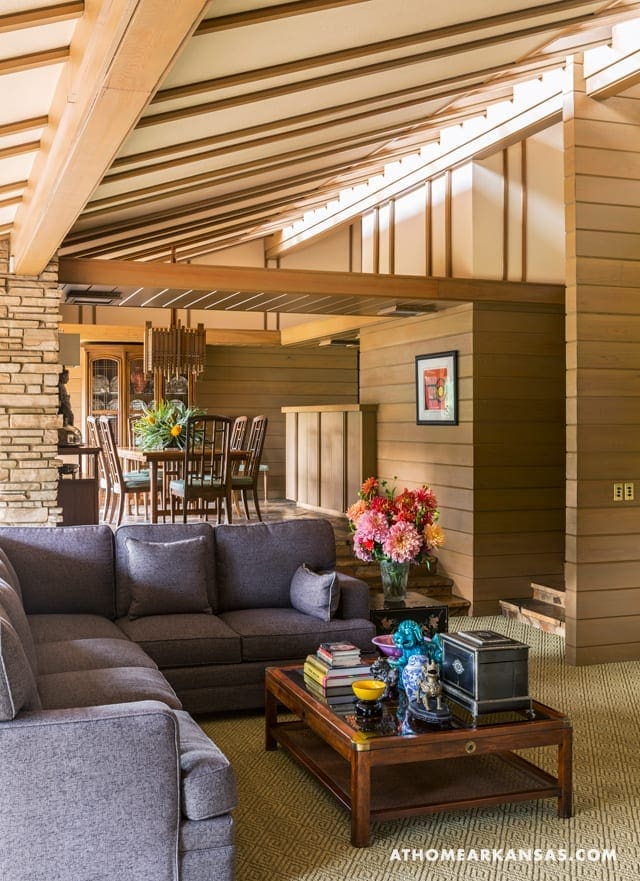
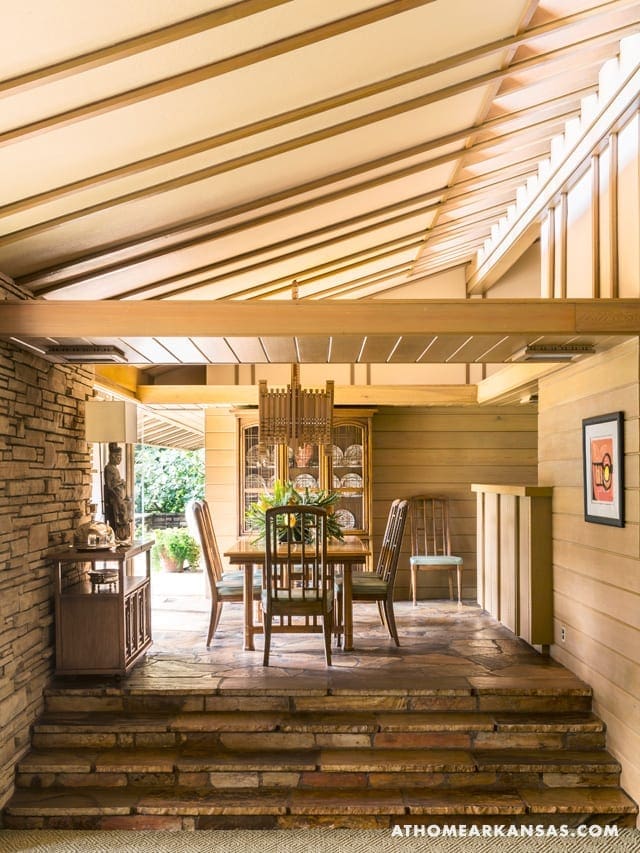
Woodward has also reviewed a number of the documents associated with the home’s construction to glean insights into the architect’s reasoning. “In Jones’s notes, it said [the Polks] liked exposed beams. The ones used in the home are steel and have been covered with wood; so [the house] is steel-beam construction. This allows for the expanse [of the elongated structure]. They also liked low-to-high, and they were big on having a sunken space,” Woodward adds. This fondness for sunken space is evidenced in the home’s main living area, which is terraced down from the rest of the floor plan.
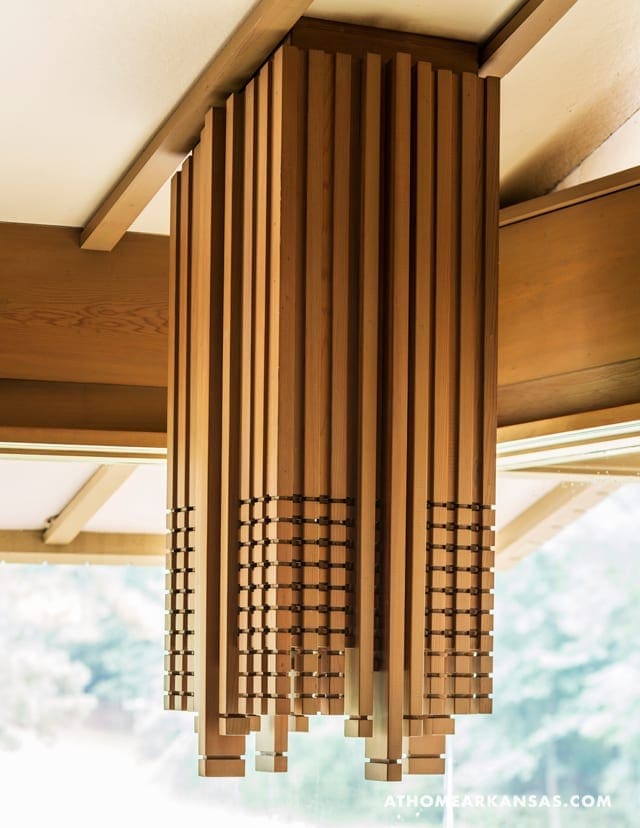
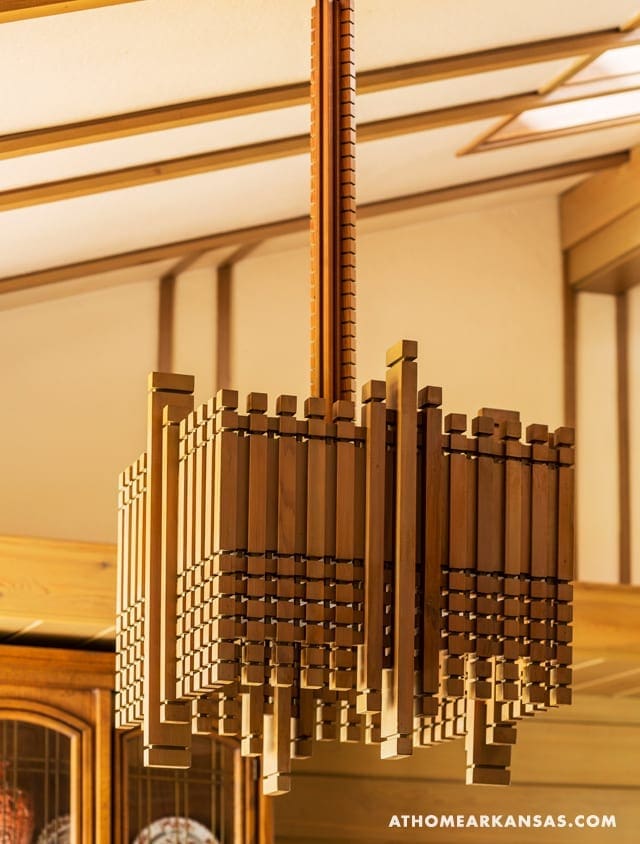
In addition to architectural details, Jones was equally thoughtful when it came to flourishes and functional pieces. Wood shavings in a scrollwork-like shape are encased in glass windows and door openings throughout the house (see the image above); built-in storage lines the hallways in an artistic yet practical manner; and light fixtures that echo the millwork seen on the walls and ceilings illuminate the rooms.
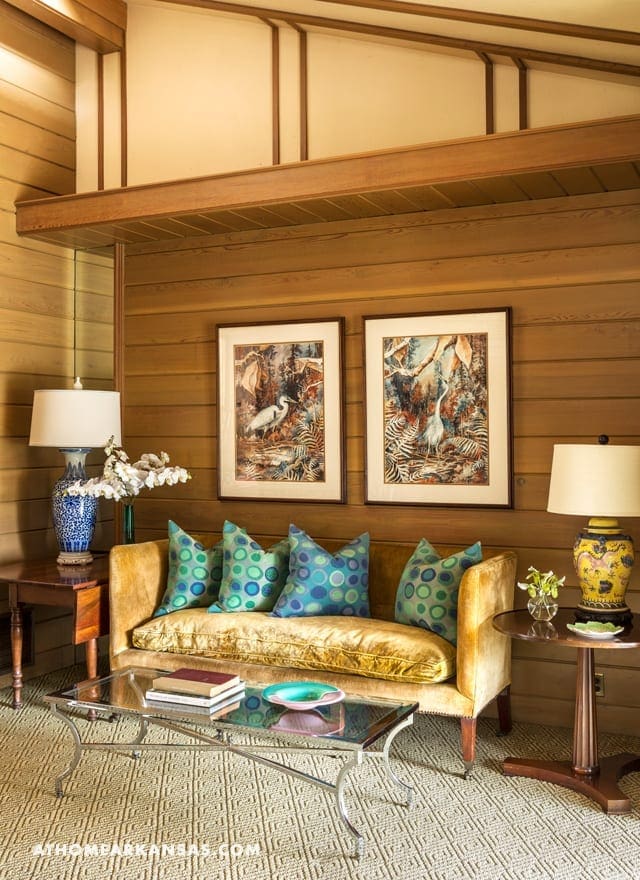
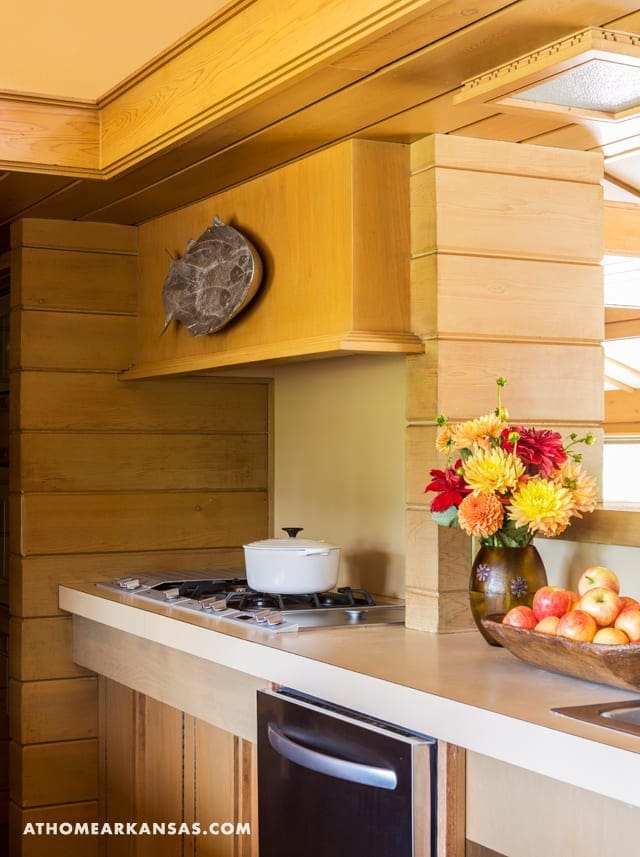
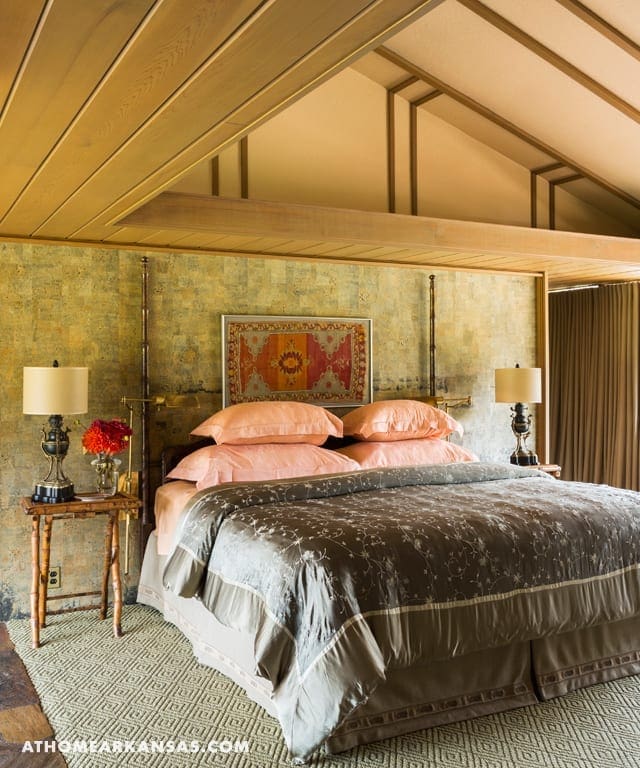
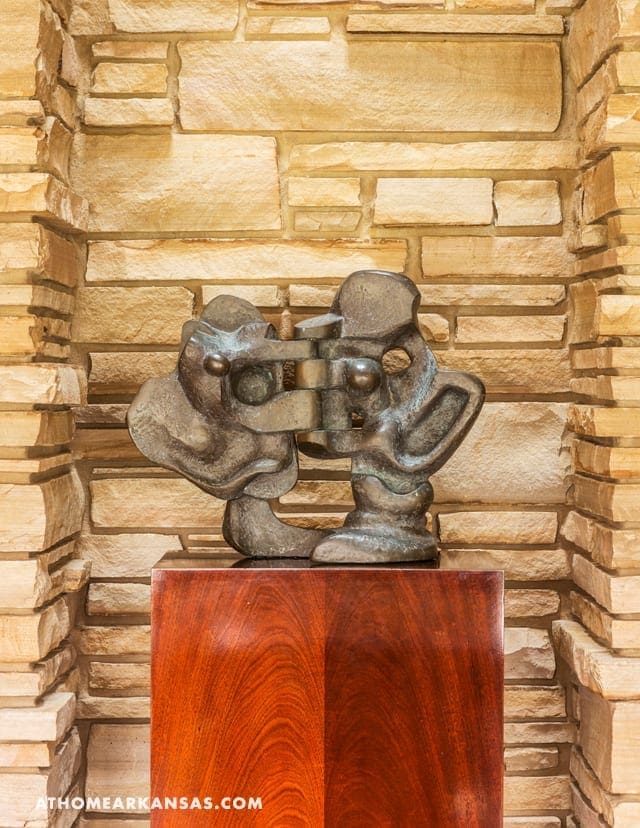
In furnishing the home, Woodward brought in pieces that fit perfectly with the time period and style of the house. He consulted with local antique and vintage shops, and also incorporated a number of items he had amassed following a downsize move to a new Little Rock residence. In a nod to his love for the state, he filled the walls with works by Arkansas artists, including Ann Downs who is from Magnolia. The dining room furniture was left by the original owners, and Woodward kept it intact, thus honoring their style. While every detail of the home is intentional, perhaps what is most inspiring is Woodward’s intentional commitment to preserving the structure and its history for generations to come.
Design Resources
Interior design M. Bruce Woodward, M. Bruce Woodward Interiors and Design, Little Rock and Magnolia, (501) 681-4630
Antiques Roy Dudley, Little Rock, (501) 666-5856, roydudleyestatesales.com
Carpet Magnolia Carpet One Floor & Home, Magnolia, (888) 609-3056, magnoliacarpetonemagnolia.com
Florals Becky Clement, Inspired by Nature, Keo, (501) 945-7226
Furniture—sofa Bassett Furniture, Little Rock, (501) 217-3860, littlerock.bassettfurniture.com
Furniture—vintage Sweet Home Furnishings/Clement, Little Rock, (501) 296-9198, sweethomefurnishings.net
Lamps The Shade Above, Little Rock, (501) 374-3555, theshadeabove.com
Roof WDR Builders, Inc., Magnolia, (870) 234-2121
