Date: 2008-03-18 14:48:13 |
 |
||||||||||||||||
| Skyrocket heritage roses add bright pops of color to the landscape. | ||||||||||||||||
 |
||||||||||||||||
The folly, designed to complement the house, is the focal point of the lower yard, and it provides garage and garden supply storage, while also offering a restful view of the gardens and house from it
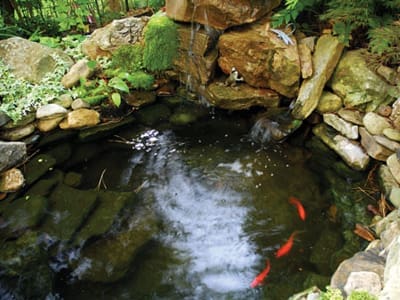
Carolyn and David Newbern’s English-inspired garden is the ideal complement to their English Tudor Revival-style home, built in 1926. “I wanted the design to be appropriate to the time period and architectural style of the home,” says Carolyn, herself a master gardener who re-created the spirit of both English and Arts and Crafts gardens with perennial borders, rock and woodland gardens, water features and even an architectural folly in the lower yard. When the Newberns purchased the home, the sloping 100-by-300-foot lot already had rock walls, a few planting areas and a St. Augustine lawn. Taking into consideration the shade and slope, the couple created curved beds for ground covers with shade-loving plants, and built raised beds, flagstone walkways and steps. “When a pine tree threatened to fall on the garage,” Carolyn says, “we rerouted the sidewalk to enclose new beds and also buried utilities—the old lemons to lemonade technique.” The asymmetrical form of the house led to similar designs in the landscape. “I try to surprise visitors with unusual garden sculptures, water features and plant choices,” Carolyn says, “all with a touch of whimsy.” Carolyn prefers using heritage and native plants, plants with four-season interest and plants that are hardy, such as shrubs, perennials and bulbs. She also likes to include items in her garden that are wildlife friendly, providing shelter and food for birds. This master gardener also enjoys mixing clematis with roses or azaleas, using purple heart in between iris and annuals and planting variegated ivy to grow up tree trunks. “I love to see plants weave around each other,” she says. She also plants herbs, including rosemary, thyme, sage, lavender, basil and dill wherever they will grow. And in order to enjoy the bottom third of their long, sloping garden, the Newberns added a building—the folly—which was originally intended to be used as a screened porch but grew to include a garage and storage for garden supplies. Fellow master gardener and horticulture specialist for the University of Arkansas’ Cooperative Extension Service, Janet Carson once gave Carolyn advice that she still takes to heart, “Have fun in the garden,” she says. NEWBERN PLANT LIST
|