
There’s the stereotypical artist dreamer, and then there’s Little Rock-based painter Matt McLeod. Balancing family, the business of art and his passion for painting, Matt has a career plan that keeps him firmly grounded. “I treat being an artist as being an entrepreneur,” he says. “I’m my own boss, and I have a lot of flexibility, but I don’t take it lightly.” When Matt decided to strike out on his own as a professional painter in 2003, the stakes were high. An established advertising man, he had built a career at several of the state’s most prestigious advertising agencies, including Cranford Johnson Robinson Woods, Stone Ward and Thoma Thoma Creative. As his career developed, so too did his interest in painting. After fifteen years of honing his skills as a hobby painter and taking lessons at the Arkansas Arts Center, Matt decided to take a risk. “Being an artist is not an easy thing,” he says. “If I didn’t feel like I had to do it, I probably wouldn’t have tried.” But Matt wasn’t about to try to make it without a plan. He started out by organizing artist workshops, which were both a welcome source of income during the first difficult months, and a chance for Matt to improve his own skill by studying with experienced instructors. Soon he was teaching his own classes. “There’s no better way to learn than to teach,” he says. By breaking down painting techniques for his students, Matt learned even more about his own distinctive style and approach to composition and color. Bold and energetic, Matt’s paintings manifest a wildness and creative freedom that offset his more serious side. A modern Impressionist painter, he says he is also influenced by the Fauvism movement, a term derived from the French word fauve, meaning wild beast, and used to describe the vivid and emotive use of color by a school of French post-Impressionist painters. His pieces are strikingly colorful, combining warm and cool tones in unexpected ways. Local streetscapes and landmarks are often the subjects of his work, but by manipulating the color tones and saturation, Matt gives these familiar sights a modern, deconstructed feel. “I paint what I know,” he says of the settings of his pieces, “but I try to paint it in a way that it can be universal.” Although he also works in acrylic, Matt creates some of his most complex and unusual color effects in oil. His skill as an art instructor is evident as he describes his oil painting technique. “Oils dry slowly and blend easily, so you can soften edges. It delivers pigment really well,” he says. “There’s something about it that’s just really pleasing to the eye. However, often the most vibrant color values are lost due to this blending.” To preserve the intense color contrasts that make Matt’s work so distinctive, he uses a chemical compound called alkyd to speed drying between layers. Once a layer is completely dry, he can introduce new, saturated colors on top without them blending into previous layers. The resulting splashes of color and contrasting high and low values are helping Matt to stand out in the art world. Represented by Blue Moon Gallery in Hot Springs, as well as T. Lamarr Fine Art in Little Rock, Matt is planning expansions to Dallas and Nashville in the near future. His piece Capital Traffic was also recently selected by an out-of-state jury to be featured on the cover of the 2008 Arkansas Artists Calendar. A working artist, Matt knows that increasing his exposure is an important key to success, but continuing to improve his skills is foremost among his plans. “There’s always room for getting better. The more you paint, the better painter you become,” he says. After five years as a professional painter, Matt is thankful for the discipline and work ethic, not to mention the marketing skills, he learned in his previous career. “Sometimes I wish that I had started right out of school as an artist. But at the same time, I feel like a lot of my success is based on the fact that I did spend 15 years in the business world, and I know how to focus my energy in a very specific way.” |


The Aspects of Design
Designer Pam Morton of Lumber One knows that in design, it takes a village. “We really do it all,” she says, “from hardware and building materials to putting the icing on the cake with all the interior finishes, flooring, fabric window coverings, bedding, flooring and wall coverings. Everything it takes to construct and complete a home.”
Pam became involved in the design of her clients’ homes as she was helping them with the materials. “The progression was natural to move on with them in finishing out the project by designing the interior décor,” she says. “Having one person helping with the design process from beginning to end gives a look of continuity.”
Her first priority when it comes to working with a client is to spend time learning how they live. “I want the project to completely reflect who they are,” she says. “I love the challenge of getting it right and capturing my client’s look, not my own. So, when I am designing my own spaces, it is very freeing.” She also practices what she preaches. When she and her husband, John, moved to Little Rock from Heber Springs two years ago, they bought the third house they looked at in the Chenal Valley area. “The floor plan lives very easily. The upstairs is our daughter Nealy’s space, and John and I completely live downstairs.”
A talented artist, Pam’s work permeates the home, providing a personal touch to almost every room. “I began to draw in the 11th grade with a No. 2 pencil,” she admits. “I taught myself to shadow and mostly draw faces. I love the work of Gino Hollander and am inspired by him.” The colorful artwork in her home is the unique accent that gives her design work a personalized punch. “I prefer to use a neutral paint as the background to show off the good stuff,” she says. “I like for the color to come into a room by the art or the great fabrics and rugs.” And art may just be the most important element in a home according to Pam. “The art a person chooses reflects who they are,” she says. “It says so much about what they love and what makes them feel good.”
…
Environmentally Conscious Building Materials
 SOYBEANS
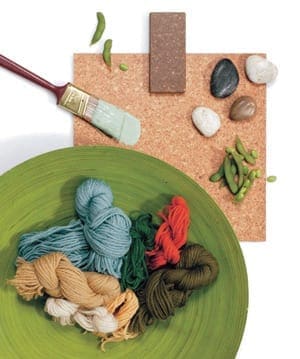
Soybeans are a rapidly renewable resource, and they are now being utilized in energy-efficient and environmentally friendly home insulation. BioFoam of Arkansas, based in Little Rock, installs soy-based, spray-foam insulation for residential, commercial and industrial purposes. This insulation, made from soybean oil, can save customers 30 to 50 percent on energy costs, and the expanding liquid fills every nook, crack and crevice. This barrier also controls wall cavity moisture problems, reduces dust and increases air quality. Bio-based insulation can be an important component to LEED certification.
CORK
Cork is a wonderful product to use thanks to its versatile nature and sustainable harvesting techniques. To make any cork product, the cork oak tree is never cut down. Instead, the bark is harvested from the tree every nine years, leaving the forest undamaged. The tree rapidly grows new bark and is not harmed during the process. Choosing cork flooring is a great way to enhance the sustainability of your home.
CONCRETE
Although concrete isn’t new to the building process, insulated concrete forms are. Smart Structures in Little Rock is building residential and commercial properties throughout the state using Eco-Block technology. Eco-Block insulating concrete forms replace wood frames with panels that easily snap together. The space between the panels is then filled with concrete that cures and hardens into a reinforced core with incredible strength. Eco-Blocks dramatically reduce energy costs, utilize recycled materials whenever possible and emit no harmful fumes or gasses. These structures qualify for Energy Star Home rating and energy-efficient mortgages. Thanks to Eco-Blocks, Smart Structures’ homes boast an airtight structure that improves indoor air quality and resists mold growth.
PAINT
Regular indoor paint gives off toxic fumes, known as volatile organic compounds, or VOCs. These VOCs are responsible for polluting indoor air, which has been found by the Environmental Protection Agency to be five times worse than outdoor air. To easily reduce the level on toxins in your home, purchase low- or zero-VOC paint. Popular brands like Benjamin Moore and Sherwin-Williams both offer this safer paint now.
BAMBOO
Bamboo is a grass, and the fasting growing wood-like substance on the planet. Moso bamboo, the variety most often used in flooring and building materials, grows to a height of 50 to 60 feet in only 18 months, and can be harvested after 4 to 6 years of growth. This compares to 30 to 60 years for comparable wood species. There is also no replanting concerns with bamboo due to its own regeneration. Bamboo can be used to build front doors, fencing, flooring, cabinetry and more, thanks to its incredible strength and flexibility and it’s light weight.
WOOL
Wool and other natural-fibers are a healthy, non-toxic alternative to standard synthetic materials in carpeting and rugs that emit volatile organic compounds. Since wool comes from shearing sheep, it’s naturally renewable and causes no harm to the animals.
HARD SURFACES
LG offers a non-porous, anti-microbial and stain-resistant solid surface that is also earth-friendly. The Eden Collection is created from a minimum of 12-percent pre-consumer recycled material, and it’s certified for recycled content by the Scientific Certification Systems. This product earns credits toward LEED certification, and is available in six colors.
…
Pop Art Style
 |
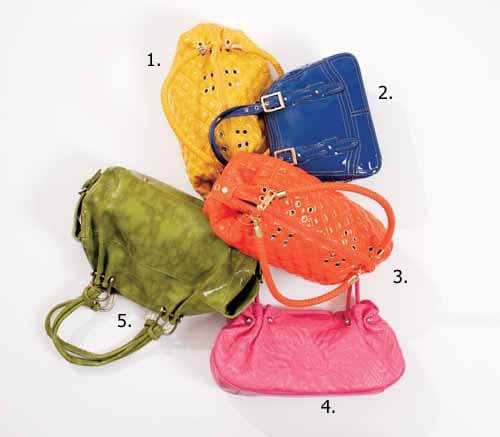
| 1. Yellow quilted Big Buddha bag, from Catering to You in Little Rock.
2. Blue Maxx handbag, from Catering To You. 3. Orange quilted Big Buddha bag, from Catering to You. 4. Pink handbag, from The Accessory Gallery in Hot Springs. 5. Big Buddha green handbag, from Wilkinson’s Mall in Conway. |
 |
| 1. Yellow quilted Big Buddha bag, from Catering to You in Little Rock.
2. Blue Maxx handbag, from Catering To You. 3. Orange quilted Big Buddha bag, from Catering to You. 4. Pink handbag, from The Accessory Gallery in Hot Springs. 5. Big Buddha green handbag, from Wilkinson’s Mall in Conway. |
How Does Your Garden Grow?

Crafted of a variety of materials, garden statuary has been a staple in grand homes over the centuries, and it makes a bold statement today as well, whether displayed inside the home or outside in the garden. An avid gardener herself, antiques dealer Debbie May, of D. May Antiques in Little Rock, relishes collecting the pieces for their architectural splendor and versatility. “Having a garden, I have always been more than a little partial to the garden pieces and have admired and collected them for the last twenty years,” she says. “I became very interested in antique architectural pieces during the mid eighties, when the architectural fragments were first being used to create furniture and as decorative additions in homes.”
An underlying classical style unifies the pieces she’s amassed, though they run the gamut of periods and materials. Carved of limestone, the quartet of European putti represent the four seasons and date to 1875, while the Italian carved marble statue of Bacchus is as recent as 1940. May has also chosen select reproductions of antiques, such as the Venus de Milo statue and fountain, which are made of incredibly durable cast stone and concrete, respectively. The terra cotta pieces, however, are more difficult to find, because the material fell out of vogue after concrete became readily available. Terra cotta was often used for architectural elements, like the urn with its removable cap and the oak leaf and acorn wreath, which was salvaged from a building in the northeastern United States and dates to 1890.
Despite their age, May encourages collectors to feel confident displaying the pieces outside. “They’re all fairly sturdy and don’t require any particular care,” she says. Because the designs share a timeless quality, they can be incorporated into almost any décor. “Any home, whether contemporary or traditional lends itself to architectural pieces,” she says. “They can be used as a work of art and admired for their uniqueness.” She loves the statuary tucked in a lush garden or used on a dining room console, while the architectural elements can be elevated as an artistic focus, displayed on a covered porch, or even applied to a home’s façade. “They are all easy to display in the home of today,” she says.
…
Natural Entertaining
When Little Rock residents Shawnee and Wayne Bruffett decided to build a poolside gathering space at their Pleasant Valley home, they could hardly imagine what it would become. “Actually, I just wanted to get a chiminea” says Shawnee, “and it snowballed.” What they got was an outdoor living space that is as functional as it is beautiful. Landscape architect Daniel Lanehart and Morris Chappell Landscaping worked together to create an area perfect for intimate family gatherings, as well as large backyard celebrations.
One of the most prominent features of this outdoor space is the large wood-burning fireplace designed by Daniel Lanehart of Arkansas Landscape. Made of flagstone and brick, it’s positioned between a built-in firewood holder and a television cabinet, and it provides almost year-round use of the space. “Personally, fall is my favorite time of year,” Shawnee says. “My kids and their friends love to go out there and make s’mores by the fire.” Two ceiling fans and an iron chandelier hang from the pergola, which shades a large teak dining table. Knockout roses and Encore azaleas provide beautiful pops of color, while columnar evergreens and Japanese maples give an elegant and manicured look to contrast the backdrop of trees and greenery surrounding the property. “Morris Chappell designed all of the lighting and landscaping, and they created the extra touches to keep the space from looking overwhelming,” Shawnee says.
The outdoor kitchen is equipped with a built-in barbecue grill, as well as a refrigerator and an icemaker for added convenience. “The backyard is always equipped for entertaining,” Shawnee says. The teak cabinetry matches the dining table and provides sleek under-counter storage. The entire area is tiled with Pennsylvania bluestone provided by Joe Murdaugh Masonry, and the stone extends from the kitchen and around the pool. Its natural highlights of blues and creams add visual interest and complement the natural surroundings. “The neatest thing about our backyard is that we want to be there,” Shawnee says. “It’s just so nice to have our own little retreat right outside our door.”
The Art of Textiles
 |
| (left to right): A bright orange, botanical-inspired motif runs along this table linen from Vintage Cargo in Eureka Springs.
Timeless and completely elegant, this white linen napkin with seed details is by Juliska. Available at Bear-Hill Interiors in Little Rock. Make a bold statement with these colorfully striped Barbizon Garance linens from Yves Delorme in Little Rock. Available at Cobblestone & Vine in Little Rock, a classic plaid print gets an update with the light blue color scheme and beautiful sheen of this textile. Shelby’s in Harrison presents this lime green and blue striped napkin to add interest to any place setting. |
Keith James

Keith James is something of a legend in the Little Rock design scene, having created amazing interiors for houses across the state, not to mention Palm Beach, San Francisco, Dallas and Washington, D.C. Despite their varied nature, he says, “they were each unique and fulfilling.” Today, he runs his design firm, along with his custom lamp operation, from inside Dauphine, his home design and antiques retail business. With everything from fine linens to one-of-a-kind furnishings and antiques, Dauphine is a longtime shopping destination on Kavanaugh Boulevard in the Heights. “I’ve been in three locations, all of which have been within three blocks,” he says.
 As a young man, Keith was asked to decorate his first boss’ office, and he quickly acknowledged that he’d found his passion. “I just realized that this is what I wanted to do,” he says. In the spring of 1973, he opened Dauphine as a small gift store and began offering interior design services, quickly gaining clients by word of mouth. “Most of my first projects were very conservative with a touch of whimsy,” he says.
Designing his exclusive collection of lamps seemed a natural next step. “I was so tired of being limited to the lamp selections that were available, that I decided to use that as a business venture and a way to create,” he says. In his travels, Keith began collecting unusual antique pieces, from candelabras and vases to urns and statuary, to transform into custom lamp bases. He paired these with luxurious, hand-sewn silk shades with exquisite trims, and a phenomenon was born. Highly sought after, his lamps are sold exclusively through Dauphine, becoming a conversation piece wherever they are displayed,
Today, Keith is most often inspired by color, and the myriad of combinations that can quickly change the look of a project. He approaches each new project as an opportunity to utilize the client’s existing pieces with select additions to make the entire space look fresh and complete. He begins with an extensive consultation, to determine the client’s present and future goals for the home. “After we learn the client’s likes and dislikes, we begin to pull samples,” he says. “We have hundreds of in-house resources such as fabric, wallpaper, lighting and custom furniture to offer.” The process is a collaboration not only with the client, but with his staff as well, who each bring unique talents to the table.
At the end of the day, however, Keith endeavors to create a space where his clients will feel fulfilled and at home, helping them to make decisions reflective of their own tastes. “The most important thing I can offer my clients is guiding them through the entire job,” he says.
…
Refreshing the Past

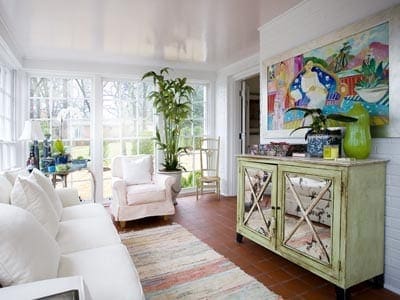
Little Rock’s Edgehill neighborhood dates back to 1925, and each home offers a glimpse of revered architecture and lush grounds. Bill and Jane Hardin’s home is no different. Built by Mr. and Mrs. Leo Griffin in 1947, the Hardins are only the third owners of the home, purchasing it from Mary Lynn and Sheffield Nelson in 2005. Although the Hardins remodeled several aspects of the home with help from Chris de Bin of Chris de Bin Construction, it retains its grandeur and historic roots.
 When Jane imagined her perfect home, she was highly influenced by the architecture and interior design of Denmark. “I traveled there in my late twenties and stayed in Copenhagen,” she says. “I loved the older homes with their bare white-washed floors, lots of paned windows and the use of glass and reflective elements, such as the Venetian plaster, mirrored tables and painted furnishings.” Each of these techniques opens and lightens the space, and Jane wanted to benefit from this in her own home. “We wanted the house to be light, and it already had wonderful windows,” she says. “Most of the house is only one-room deep, so we get sunlight from the south and the north. We decided not to use window treatments so as not to block the sun, unless privacy is an issue in the room.”
The Hardins also added several architectural elements to complement the home’s structure. “We installed the wood-paneled ceilings in the living room and dining room, and painted them with high-gloss paint, which I really like due to its reflective properties,” she says. “We replaced the glass panels in the doors with etched glass, and replaced the glass in the original front door with beveled glass.”
Continuing Jane’s Scandinavian design leanings, she chose a cool blue and green color palette that can be seen in the master bedroom, the striped hallways and in the dining room. The living room is awash in relaxed cream colors, and plays an important role in the day-to-day use of the home. “We found the daybed that we use as a sofa in New Orleans the week before Katrina came ashore. We knew it hadn’t been shipped before the storm, and with the shop’s phone lines dead, we decided to forget about it, knowing they had more important things to worry about than our daybed,” says Jane. “After two and a half months, we got a call saying they had our daybed and were shipping it. We were amazed!” A unique birdhouse also adds to the enjoyment of the room. Bill discovered the piece at Pflugrad’s Antiques in Little Rock where it was being used to display plants. “He saw the potential for a bird cage, and I had always wanted finches,” Jane says. “They create such a lovely sound, especially when our daughter and friends gather to play the piano.”
…
Mid Century Magic
When Kathleen and Len Pitcock were looking for lake houses in Hot Springs, they didn’t count on falling in love with a historic home miles from Lake Hamilton. “We saw this house on the internet,” says Kathleen, “and I said, ‘we’ve got to see it!’” The couple, who lived in a smaller, ranch-style home in Little Rock were not thinking about a permanent move to Hot Springs, but the sprawling 5,000-square-foot home built in 1955 by Peter Dierks Joers and still owned by the same family proved to be too much to resist. The Pitcocks decided to give up the lake house idea, sell their Little Rock home and make the move to Hot Springs.
 “This was the perfect house for us,” says Kathleen, who had been collecting mid-century modern furnishings and accessories for years. The historic home is situated on six and a half acres only a few minutes from downtown, and Kathleen, who grew up in Hot Springs, was glad to be back home. Len and Kathleen are so happy with their find that they don’t even mind commuting to their jobs in Little Rock. Instead of a lake house, they found their dream house.
…
- « Previous Page
- 1
- …
- 216
- 217
- 218
- 219
- 220
- …
- 230
- Next Page »
