 |
| “We always look for the highest quality pieces that will bring the most joy to our clients,” Renée says. “It’s the attention to detail and the research we do that make us different.” |
 |
| This cigar box, circa 1850, is from the Napoleon III period and is inlaid with mother of pearl and bronze. With a bottom drawer fashioned for cigar cutters and several top drawers with indentations for individual cigars, this is truly a gentleman’s piece. |
 |
| This Art Deco bistro chair is paired with a Louis Philippe walnut chiffonier, a gentleman’s chest featuring a marble top. A buffet deux corps, translated a buffet with two parts, stands in the background. |
Arkansas Antique Hunters’ Guide
French
 |
| Hand-carved Louis XIII chair, petite tray-top table, French Quarters, Fayetteville. Hand-painted screen, marble and bronze Bacchus bust, Marshall-Clements, Little Rock. Aubusson pillow, Antiques on Kavanaugh, Little Rock. Porcelain bowl with gilt bronze ormolu, The Antique Co., Little Rock. |
Details
 |
 |
 |
Offering a truly elegant collection of antique furnishings, the French styles from the 17th to the 19th centuries ranged from restrained looks to opulently adorned pieces. From Louis XIII to Louis XVI, the majority of wood furniture and accessories were crafted from oak and walnut, with popular techniques such as turned or twisted legs being used on chairs and tables, in addition to the classic cabriole leg style. Heavily carved accents, such as animal and nature motifs, could be found on chair backs and on case goods, and the art of marquetry—using wood veneers of various shapes to create often elaborate and geometric designs—frequently dominated large and small furnishings alike.
Other ornamental hallmarks of French furniture design include the use of gilt bronze, or ormolu, on the knees of cabriole legs, chair backs and mounted on the corners of desks, chests and other large pieces of furniture, architecturally inspired mouldings on case goods, and marble tops on console tables and desks.
 |
| Hand-carved Louis XVI table de milieu topped with miniature Louis XVI chest and 19th-century bronze doré grandiole with Baccarat crystals and malachite base. Hand-carved walnut Louis XV-style chair with green velvet upholstery. All from French Metro Antiques, Fayetteville. |
English
 |
| Oak and tiger oak 19th-century smoking chair, tea caddy set, Morris Antiques, Keo. Leather-topped Chippendale console with matching bench, part of a pair, D. May Antiques, Little Rock. |
Perhaps the name most synonymous with English furniture is that of Thomas Chippendale. The epitome of classic British design, Chippendale’s works have been replicated since their debut in the early 18th century, and are still copied today. And although Chippendale is primarily known for his chairs, the cabinet maker turned furniture designer created everything from Asian-inspired suites of furnishings to heavily decorated desks and chests to simple chairs and tables. Hallmarks of such designs include cabriole legs with decorated “knees” and ball-and-claw feet on chairs and tables, the use of woods such as oak and maple, and intricately designed splats and stretchers on chairs.
Details
 |
 |
 |
Asian
 |
| Tibetan chest, Chinese rice bucket and leather Geisha shoes, Pacific Rim Imports, Little Rock. Red jade teapot and low elm wood bench, Indigo Home, Little Rock. |
Wooden furniture has been a staple in Asian culture since ancient times. An excavation of a site dating back to 250 BC revealed wooden furniture with the popular lacquerware decoration that is still sought-after today. The use of lacquer was not only a decorative accent, but it also had a practical application, as the all-over covering made the furniture more resistant to insects. Other hallmarks of Asian furnishings include the frequently lightweight nature of the items, which allows for easy transporting. Native woods, such as elm wood, rosewood and sandalwood, were prized mediums for cabinet and furniture makers, while bamboo was typically reserved for nonessential pieces. And although lacquerware and other means of ornamentation helped create decidedly opulent and colorful furnishings, the underlying design remained clean and simple, with occasional curves and flourishes.
…
Glass Act
 |
Continental Drift
“It’s the charm and character of a piece that really grabs me,” says Kirby Whetstone, owner of The Antique Co. in Little Rock, where she specializes in 17th- and 18th-century Italian, French and English antiques. Whetstone, who recently returned from an east-coast buying trip, offers some insight on why Continental antiques remain popular not only with dealers such as herself, but also with collectors. “Early pieces from the 17th and 18th centuries are original, and they seem to have better craftsmanship,” she says. “Many items from the 19th century are reproductions, which don’t have as great an appeal as originals, and they also don’t carry the same investment value. In my market, 18th century is very popular, although several 19th century designs are in demand as well.”
Whetstone also believes that the character of earlier pieces, such as the 18th-century French commode that anchors the entryway, lends to their value and desirability. “The honey color of the commode exudes a warmth that really appeals to buyers,” she says. But ultimately, she’s searching for things that she knows both her clients and herself will be pleased with. “I buy what is, to me, beautiful, and what I think my clients will want at a price that’s acceptable,” says Whetstone. “These things are timeless, and they do not go in and out of style.”
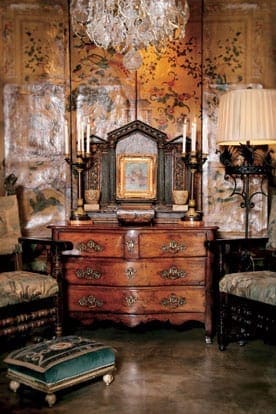 |
Creating a warm welcome, an 18th-century French commode is the centerpiece of our entryway. Crafted of fruitwood and featuring its original patina and hardware, the commode is designed in the style of French Country. The backdrop, a mid-19th-century hand-painted leather screen, strikes a stunning pose without overshadowing other pieces, such as a pair of 17th-century Italian state chairs crafted of walnut and covered in an original tapestry, a circa-1820 pair of Charles X bronze three-arm candelabra, and a late-18th-century Italian reliquary. An Italian crystal chandelier hangs above the scene, while a late-19th-century iron pricket lamp flanks the commode. |
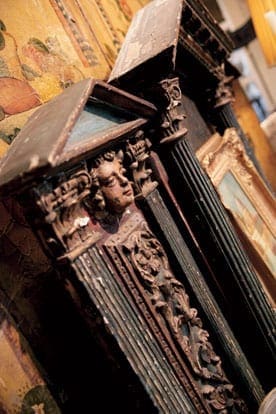 |
This Italian reliquary was likely produced during the late 18th century, when wealthy and religious Europeans often had chapels in their homes. Reliquaries were used as a sort of altar, and often held the bones of saints. |
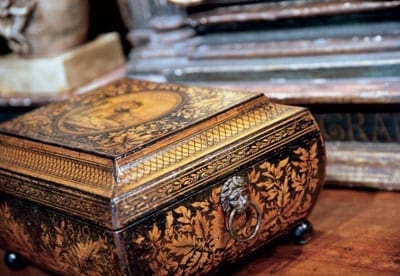 |
This English Regency penwork sewing box is a wonderful example of the value of original work—the decoration was created with pen and ink, and the box still boasts its original lion handles and bun feet. |
…
Occasional Style
The early part of the 19th century is characterized by the development of furniture designed for specific purposes. Of such pieces, the small-scale occasional table stands out thanks to its multi-functional nature, and because its size made it easy to transport. Because these tables can often be seen from all sides, they were usually veneered on the back as well as the front, unlike side tables, whose backs were hidden when set against a wall. Tables produced around the 19th century were primarily associated with leisure activities, such as chess, reading, painting, or ladies’ activities, so pieces like sewing tables and commodes were given considerable attention. Kirby Whetstone, co-owner of The Antique Co. in Little Rock, offers customers an assortment of occasional tables in varying sizes from around the world.
An English painted-lacquer sewing table, circa 1880, from The Antique Co. is a classic example of these types of tables. It features a lid with six small compartments ideal for needles, threads and buttons, one larger compartment perfect for scraps of cloth, and a mirror that is revealed when the tabletop is opened.
One style of occasional table, the commode, is characterized as a chest with deep drawers and was first introduced in the late 17th century, continuing to appear in varying styles throughout the 1900s. Whetstone displays two different designs of this type of table — an English red chinoiserie lacquer commode, circa 1900, featuring a beautiful Oriental motif, vertical curves, known as bombe’, and a horizontal serpentine skirt on the bottom, and a circa-1850 French fruitwood commode with a lined top drawer as well as a sliding door compartment, perfect for holding larger items.
In the early 18th century, around the reign of Louis XIV, an evolution of the occasional table occurred, most noticeably in the form of leg shape. The cabriole leg was introduced into the French court — a look based on the shape of an animal’s hind legs, which may have originated from Chinese influence. The finest pieces most often had “knees” that were highly decorated. Ormolu mounts, which were originally designed to protect veneer, provided such decoration and were often made of cast bronze and given a gilt finish. Stamped or painted leather also began appearing on tabletops during this period, and in the earlier part of the 18th century this decorative leather was not only used for upholstery, but also for wall coverings.

Perfect for storing trinkets of all sizes, the hinged English painted-lacquer sewing table also boasts a mirror inside the top. The table’s delicate painted motif is a feminine nod to its role as a sewing table. |
 This English red chinoiserie lacquered commode, circa 1900, features a beautiful Oriental motif, vertical curves, known as bombe, and a horizontal serpentine skirt on the bottom. One interesting feature of this piece is the versatile small pullout shelves and drawers. |
 The dainty, English Adams-style table, circa 1900 is perfect for setting beside a chair and lightweight enough to be moved around easily. Four legs that are joined by cross-stretchers, as was common during this time period, support the painted octagon table. |
 With three pullout shelves that would have been used for displaying candles and gilded mounting on the legs, it’s easy to imagine this occasional table nestled in a castle in the French countryside. The black leather top also made it an extremely functional piece. |
…
- « Previous Page
- 1
- …
- 6
- 7
- 8
