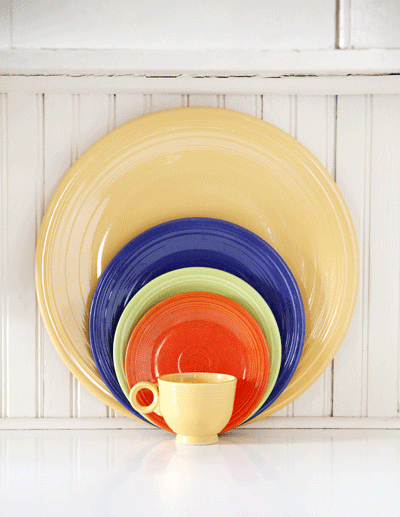
When Homer Laughlin China Co. introduced Fiesta ware in 1936 it became an instant success. Not only did the dinnerware possess bold hues at a time when home design was experiencing big jolts in color, its simple design and streamlined shape made it a compatible option for adding to existing china collections. It also allowed for mixing and matching pieces rather than purchasing entire sets, and most importantly, it was durable. Combine all of this with affordable prices, and Depression-era women and their families simply couldn’t get enough.
Reflections of History
Kirby Whetstone, owner of Antique Co. in Little Rock, found her calling as an antiques dealer while she was a collector. “After years of studying and collecting antiques that I loved, I decided to become a dealer,” she says. “I was a partner in Antiquarius for 25 years, and I opened Antiques Co on my own almost four years ago.”
Whetstone specializes in 17th-, 18th- and 19th-century continental furnishings and accessories for individuals and interior designers alike. Through her travels, she hand picks pieces, and focuses on high-quality finds. “Every time I travel, I’m working,” she says. “I just got back from Indo-China and brought home some beautiful ancient pottery.”
One of her favorite current collections is this selection of mirrors. “I find the history of mirrors to be very interesting,” she says. “The Venetians discovered how to make them, and originally the frame was simply to protect the mirror itself.” In today’s market the frame now has more value than the actual mirror, Whetstone explains. “Thanks to their multitude of uses, mirrors always play a key role in a home’s interior design and can truly transform a room.”
Whetstone’s mirrors vary in style from English to Italian and Venetian, but all boast beautiful gilt frames and original glass. The pair of Venetian gilt-wood, etched glass mirrors, circa 1825, features a man and a woman, and she notes that they must have been commissioned pieces since the images do not face each other, which is traditional. The English convex mirror is circa 1810, and it has a soft, elegant design. “They are very popular, and people seem to relate to the really good-quality English style.”
The ornate northern Italian selection is circa 1716, and its shapely form and detailed carvings make it an ideal focal point, while the French Régency square mirror is circa 18th century. “We can’t seem to keep these Régency mirrors in the shop,” she says. “They are very in fashion right now.”
Whetstone reflects on her time in the antiques business as a blending of her interest and her career. “I’ve been able to blend my passion with my business, and I’m very fortunate for that,” she says.
…
Vintage Shimmer and Shine
“I love finding a throw-away and making it into a treasure,” says Kaylene Shepard, who has turned that philosophy into a business at her Eureka Springs store Something Simple, where she gives vintage home furnishings and accessories new life. In order to blend her mix of true antiques and newer flea-market items, Kaylene sticks with a neutral color palette and covers all her goods in shades of white. “I have always been a fan of cream and white because they’re timeless and work in any room,” she explains, “and I use the same palette when I decorate for the holidays.”
Working with elements she’s found through years of flea market and antique mall visits, Kaylene creates unique, hand-made ornaments and accessories. Here, her inspired ideas with suggestions for incorporating them into your own home.
Create & Trim a Twig Tree
Kaylene cut a well-shaped tree branch and sprayed it with several coats of white paint. She had a wooden cube cut to serve as a stand, had a large hole drilled into the top, cemented the branch inside the hole, added pea gravel to fill the remaining open area, and then spray painted the stand and rocks white. She trims the resulting tree with both hand-made and vintage ornaments.
![]() |
Spring for Ornaments
Springs from a flea-market-find daybed were the starting point for Kaylene’s corkscrew ornaments. She cut out the springs, painted them white, and then dressed them up with vintage ribbon and antique treasures including chandelier crystals and glitter snowflakes.
![]() |
Fabricate Vintage Flowers
Ideal for topping packages, Kaylene’s flowers are made from old zippers and tape measures. She makes several six-inch loops with the zippers and four-inch loops with the tape measures and secures them into a flower shape by sewing or hot gluing them together. She then embellishes them by gluing on whatever vintage finds she has on hand—buttons, trim or even old watch faces.
…
Like Mother, Like Daughter
It comes as no surprise that Renee Hunt, owner of French Metro Antiques in Fayetteville, likes to collect antiques, but one collection that is especially dear to her is the growing assortment of French papier mache pieces that she shares with her 14-year-old daughter, Camille. “I have other favorites, but always planned for this one to be Camille’s,” Renee explains. “I wanted her to have a memory of her mother going to France to purchase antiques.”
Renee received the first piece, a crumber used to clean a linen tablecloth after meals, as a gift from a client, “a very Southern woman from New Orleans,” Renee remembers. “Then I began looking for them on buying trips and eventually I didn’t want to put them in the store to sell.” Camille was a little girl at the time, but already showed an interest, and the mother-and-daughter duo has since amassed 14 beautifully preserved pieces, all found near Paris during visits to France.
However, their rarity means that Renee doesn’t find one on every trip. Used in France beginning in 1850, during the reign of Napoleon III, papier mache allowed artisans to shape smaller objects not by carving or cutting but by molding. Translated as “chewed up paper,” it consists of paper paste with a strong glue binder, meaning the material is very fragile. Furthermore, their delicate hinges and mother-of-pearl inlay are easily broken with neglect or heavy use. “We like our boxes to have working hinges,” Camille explains. Making their collection especially rare, every piece also has intact abalone-colored mother-of-pearl and even maintains a shiny lacquer finish.
…
Going Home with Bronze
“Collecting is an occupational hazard,” says Bob Finkbeiner, co-owner of Trianon Antiques in Little Rock. “I can’t help but have some favorites that work their way into my own home.”
A passion for antiques began early for Finkbeiner, who grew up on a military base in Germany and had the chance to tour European museums frequently with his family. Classical bronze statues were highlighted in many of the museums, and as he began his career as an antiques dealer he started acquiring small statuary for his personal collection. “I always noticed the bronzes wherever we went, and was intrigued by their history and level of detail,” he says.
![]() |
![]() |
![]() |
Most of the items in his collection date back to Europe’s Grand Tour days of the late 17th through early 19th century, when young men traveled the continent to learn about art and culture. Bronze replicas of each country’s most notable rulers and monuments were purchased as souvenirs, and during the last century these treasures began to be readily available in antique stores.
Finkbeiner’s extensive collection now includes Roman temples and ships used as ink wells, statues of Napoleon, Caesar, and Greek or Roman gods, vessels commemorating England’s Warwick Castle, as well as decorative urns and tazzas (shallow bowls on a pedestal). In acquiring these finds, he uses his antiques dealer expertise to uncover the best examples of each style. “With bronzes, you want a great patina and a high level of detail in facial features or decorative elements,” he says. “Many of them are signed or bear a foundry symbol, and that increases value.
As with most antiques, rareness and popularity are key factors in determining the value, and Finkbeiner notes that items on Sienna marble bases and Napoleonic statuary are highly prized. “Good quality, popular bronzes start at about $1,000, and prices increase from there,” he says. Antiques stores and dealers in Europe and around the U.S. have been his best means of adding to his collection, as well as occasional auctions. He also notes that since bronzes have been collected for centuries, a wealth of books and Internet resources are available. “They’re a classic,” he says, “and that makes it easier to become educated.”
![]() |
![]() |
![]() |
An Antiques Dealer’s Tips for Collecting
- Focus on collecting what you love rather than what seems most profitable, unless you undertake this as a business venture. If you buy what you love, you’re more likely to stay motivated in the long run.
- Start small and don’t go overboard until you’re sure this is a long-lasting interest, one that won’t frustrate you if the items are difficult to find or too expensive.
- Consider starting a few collections, one that includes items that are easier to find and less expensive, and another more significant collection. This will help you increase the variety of places you can hunt for your treasures—from garage sales to antique stores and more.
- Educate yourself with books, Internet research or a dealer who specializes in the area you collect.
- If you develop a good relationship with a dealer you trust, he or she will often look for items with you in mind.
- Work on building your collection when you travel, which can take you into some interesting stores and places that you might not otherwise have seen.
…
One Smart Cookie
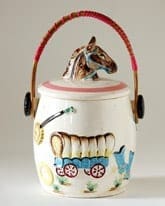
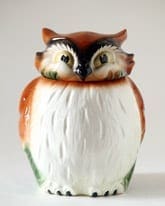
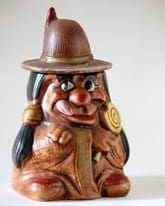
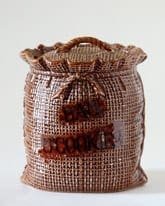
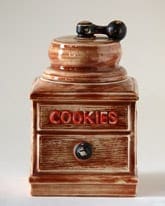
Jo Grounds knows a thing or two about cookie jars. An avid collector since the mid 1970s, she has always loved antiquing and naturally gravitated toward the pretty colors and personality of the cookie jars she encountered in antique stores and flea markets. “It’s the whimsical nature of it,” she says of her collection. “They make me happy.” She has since amassed more than 500.
Jo Grounds knows a thing or two about cookie jars. An avid collector since the mid 1970s, she has always loved antiquing and naturally gravitated toward the pretty colors and personality of the cookie jars she encountered in antique stores and flea markets. “It’s the whimsical nature of it,” she says of her collection. “They make me happy.” She has since amassed more than 500. And she speaks of each one as if it were an old friend—recalling in detail the story of how and where she acquired it, whether on a family trip, out shopping with friends or at a roadside church sale.
![]() |
![]() |
![]() |
For the past 17 years, Jo and her twin sister, Jan Smith, have celebrated their birthday with a special antiquing road trip, which has also contributed to Jo’s swelling collection. “Every year we go somewhere different,” she explains, noting excursions as far away as Missouri, Oklahoma, Texas and Louisiana. Regardless of monetary worth, the ongoing search for a cookie jar that simply makes her smile is what most appeals to this collector. “I’m not a purist,” she says. “I pay accordingly, but if it’s got a chip or a nick and I like it, I’ll buy it anyway.”
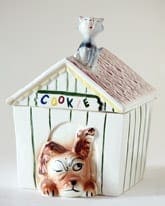
However, many of Jo’s more collectible finds date back to the 1930s or 1940s and were produced by some of the companies that are the most sought-after by today’s collectors. Cookie jars gained popularity in America during the Great Depression as glass jars with screw-on lids. But as ceramic became the material of choice, they began to surface in nearly every imaginable shape. Particularly in Jo’s collection, coveted designs by Shawnee Pottery, American Bisque, McCoy Pottery, Brush Pottery, Napco and Sierra Vista all make appearances. One of Jo’s most loved discoveries, from Sierra Vista, depicts a cat sitting on a doghouse, especially rare since the easily broken cat is still intact. And a distinguishing feature of her McCoy jars, some of the first she acquired, is that they have faded over time. They were cold painted, or decoratively painted after they were fired and glazed, while the jars that have maintained their color were painted before the glaze was applied.
![]() |
![]() |
![]() |
In recent years, Jo has turned to eBay in her ventures, which has proven to have its advantages and disadvantages. “It takes a little bit of the fun out of it,” she admits. Although eBay brings a whole new world of cookie jars to her fingertips, Jo warns new collectors about the prevalence of online reproductions. In particular, she points out that while the Brush and McCoy companies did merge, they never made an original cookie jar labeled “Brush-McCoy,” as some online sellers might suggest.
An illustrated reference book by noted author Ermagene Westfall (An Illustrated Value Guide to Cookie Jars) is an important guide for collectors and has served Jo well over the years. But considering her vast collection and knowledge on the subject, it’s about time Jo wrote a book of her own. “It can be an addiction,” she laughs. “It’s not a bad thing.”
…
The Children’s Collection
![]() |
![]() |
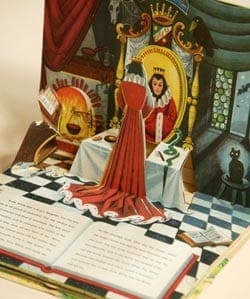
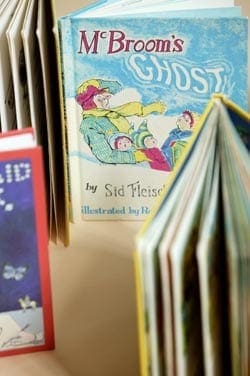
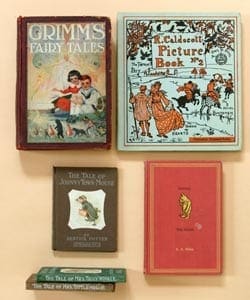
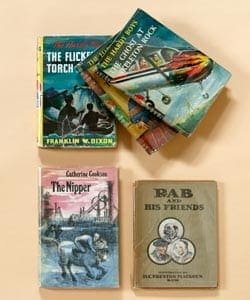
Some of the best-loved children’s books, from a 1941 edition of Peter Rabbit to a first edition Madeline from the same era, line the shelves of antiquarian bookseller Myra Moran’s home in Rogers. Though she sells a wide variety of genres through her online business, Trolley Line Books, she notes that children’s stories are a perennial favorite for the memories they hold. Finding these cherished books in good condition, however, can be a more difficult matter. “The books people enjoy the most,” says Moran, “are generally the most worn.”
While condition is a critical factor in setting a book’s resale worth, she notes that supply and demand ultimately determine value. “In the end, price is based on how many copies are available and how many people want the book,” Moran says. “As with any collectible, the more rare, the more in demand, the higher the value.”
![]() |
![]() |
![]() |
![]() |
Moran and other antiquarian booksellers will soon be showing their wares, including children’s books, at the Arkansas Book & Paper Show, held in early August at the Jacksonville Community Center. She offers starting collectors a few tips for evaluating their current books and potential purchases:
First Edition:
In the book collecting business, this means the first appearance in print—which can differ from the publishing industry, where the term can be used to indicate that the book was reprinted without changes from its initial release. A variety of identification guides and online sources are available to help distinguish between the two.
Dust Jackets:
“An original dust jacket can significantly increase the value of a book, as much as doubling the price,” says Moran. Since the jackets usually incorporate illustration or art, they create a visual connection to the story. She adds that they’re also a way to help determine if the book was part of a club, like book of the month—which generally decreases value.
Illustrations:
With children’s books, especially picture ones, the illustrator can be more important than the author. She notes that Maurice Sendak is a good example of this, with his first editions carrying some of the highest prices in the children’s books market.
Research:
Talking with booksellers, visiting stores carrying used and rare books as well as checking online sources is a good way to understand the market better and assess value. The Antiquarian Booksellers Association of America (www.abaa.org) includes articles on their website dedicated to collecting children’s books, as well as a list of some of the most collectible ones from the last century.
Moran notes that books can be a good investment, since in general they appreciate in value between 5 to 10% per year. But the main reason to start a collection, she says, is to refresh those childhood memories. “Everyone can have a shelf or two of personal favorites,” she adds.
Arkansas Book & Paper ShowSponsored by the Arkansas Antiquarian Booksellers Association Saturday, August 8th, from 9-5 and Sunday, August 9th, from 10-4 Jacksonville Community Center (Hwy 67/167 & Main Street) Admission $5 … |
Cabin Fever
A Well-Appointed Table
Reflections of History
- « Previous Page
- 1
- …
- 4
- 5
- 6
- 7
- 8
- Next Page »